
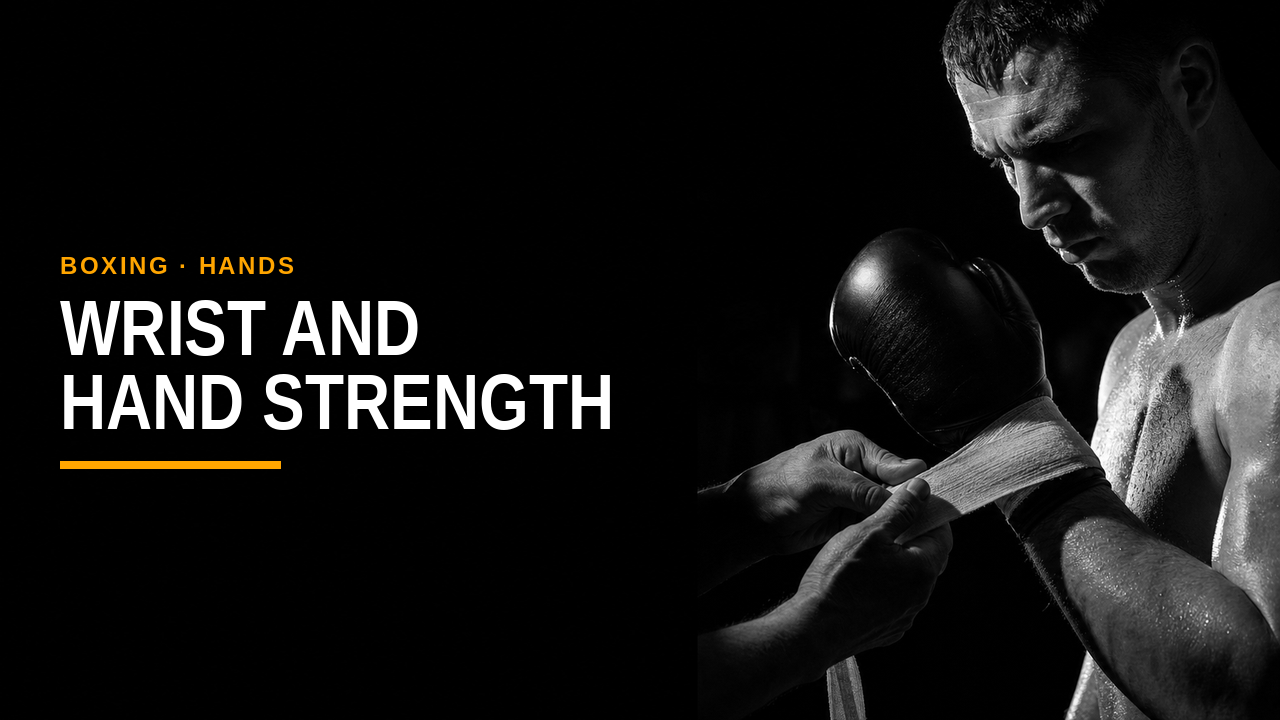
The Importance of Wrist and Hand Strength for Boxers
Mar 14, 2023Strong hands and wrists do two jobs for a boxer: they let you land hard without folding on impact, and they keep you training. Hand and wrist injuries are among the most common problems in competitive boxing — a longitudinal study of the Great Britain Olympic boxing squad tracked them across eight years of training and competition. Build the hands and wrists on purpose, not by accident.
Start with the full framework
This article covers one piece of the picture. For how movement, conditioning, strength, power, and fight-camp load fit together for a boxer, read Boxing Strength and Conditioning: The Complete Guide.
Related reading: Grip Strength for Fighters and Grapplers.
Your Fist Is The Last Link In The Chain
Punching power does not come from your hands. It starts at the floor, runs through your hips and trunk, and finishes at the knuckles. But that last link decides how much of it actually arrives. A loose wrist bleeds force on contact and it is the thing that breaks.
Think of it the way you would think about tires. You can build the biggest engine in the world and it means nothing if the rubber gives out. Your hands are the rubber. Everything you have built underneath has to transfer through two small joints and about thirty bones, and it has to survive doing that thousands of times a week.
I have coached fighters since 1998. The ones who stay in the game are not always the strongest punchers. They are the ones whose hands still work in year ten.
The Injury Problem Is Real And It Is Documented
This is the part that is not up for debate. Hand and wrist injuries are a well-documented, recurring problem in boxing across every level of the sport.
A prospective study followed the Great Britain Olympic boxing squad from 2005 to 2012 and recorded hand and wrist injuries throughout — in elite, professionally supervised athletes with full-time medical staff (Hand, 2017). A clinical review in Hand Clinics covers the same territory across boxing and the martial arts and lays out the injury patterns that show up again and again (Hand Clinics, 2017). The pattern has been described in the sports medicine literature going back decades (American Journal of Sports Medicine, 1987).
If it happens to Olympic squads with full medical support, it will happen to you in a gym with a heavy bag and a roll of tape. Plan for it.
What Grip Work Actually Buys You
Let me be straight about what the research does and does not say, because there is a lot of confident nonsense written about grip strength and punching power.
There is good evidence that targeted training programs change punch performance (Sports, 2026). What I have not seen is a clean study proving that squeezing a gripper adds pounds to your cross. Anyone who tells you grip work is worth a specific percentage of your punching power is making it up.
Here is what I will stand behind after twenty-plus years of watching it:
- A stiff wrist delivers more of what you already have. Force that leaks at the joint never reaches the target.
- Strong hands let you hit the bag harder for longer. Most guys stop working the bag because their hands are done, not because they are winded.
- Durable hands mean uninterrupted training. A month off with a sprained wrist costs you more than any grip routine could ever add.
- Grip holds up under fatigue. Round eight is where sloppy wrists turn into broken ones.
That last one matters most. The compounding win is not a harder punch this month. It is four more years in the sport.
How To Train It
Keep it simple and keep it frequent. Hands respond to regular, moderate work better than to occasional beatings.
- Wrist work in all directions. Curls and reverse curls, radial and ulnar movement. Light weight, controlled, high reps.
- Hold heavy things. Farmer carries, dead hangs, thick-bar holds. Nothing builds a grip like carrying a load until you want to put it down.
- Open-hand and finger work. Rice bucket, plate pinches, towel hangs. This trains the small stuff that tape cannot replace.
- Punch with intent on the pads. Correct technique is grip training. A fist that lands right is a fist that stays healthy.
Three sessions a week, ten to fifteen minutes, tacked onto the end of your regular work. That is enough. This is not a program on its own, it is insurance on everything else you do.
Bottom Line
Do not train your hands because a study promised you a percentage. Train them because your hands are how you make a living in this sport, they are the most commonly injured part of a boxer's body, and no one has ever regretted having a grip that outlasts the other guy's.
Related reading: why boxers put their hands in rice — the grip and forearm protocol that builds wrist stability under punch impact.
Punch harder in round ten than round one.
Start with the free Boxer’s Training Rules Cheat Sheet — the rules that decide whether your work in the gym shows up under the lights. Or step into THE PHYSICAL BOXER, built around punch power, hand and wrist durability, footwork that holds, and conditioning that lasts the full fight.
Get the Free Boxer’s Training RulesGet THE PHYSICAL BOXERHit hard. Stay standing.
What is your go-to grip and wrist routine? Drop it in the comments below.
References
- Loosemore M, et al. "Hand and Wrist Injuries in Elite Boxing: A Longitudinal Prospective Study (2005-2012) of the Great Britain Olympic Boxing Squad." Hand, 2017. https://pubmed.ncbi.nlm.nih.gov/28344531/
- "Hand and Wrist Injuries in Boxing and the Martial Arts." Hand Clinics, 2017. https://pubmed.ncbi.nlm.nih.gov/27886844/
- "Hand injuries in boxing." American Journal of Sports Medicine, 1987. https://pubmed.ncbi.nlm.nih.gov/3661815/
- "Effects of Specific Training Programs on Punch Performance." Sports, 2026. https://pubmed.ncbi.nlm.nih.gov/42188570/