Grip Strength for Fighters and Grapplers
Aug 15, 2026Updated August 2026
Coach's Note: Strong hands matter because fighting is full of contact. You grab a wrist, fight for an underhook, hold a collar, carry a bag, pull on a head, or keep your own wrist straight when somebody is trying to take it away. I have coached athletes since 1998, and the lesson is simple: do not chase a cool grip number. Build hands that can hold position, stay useful when you are tired, and come back ready to train again. — Corey
Table of Contents
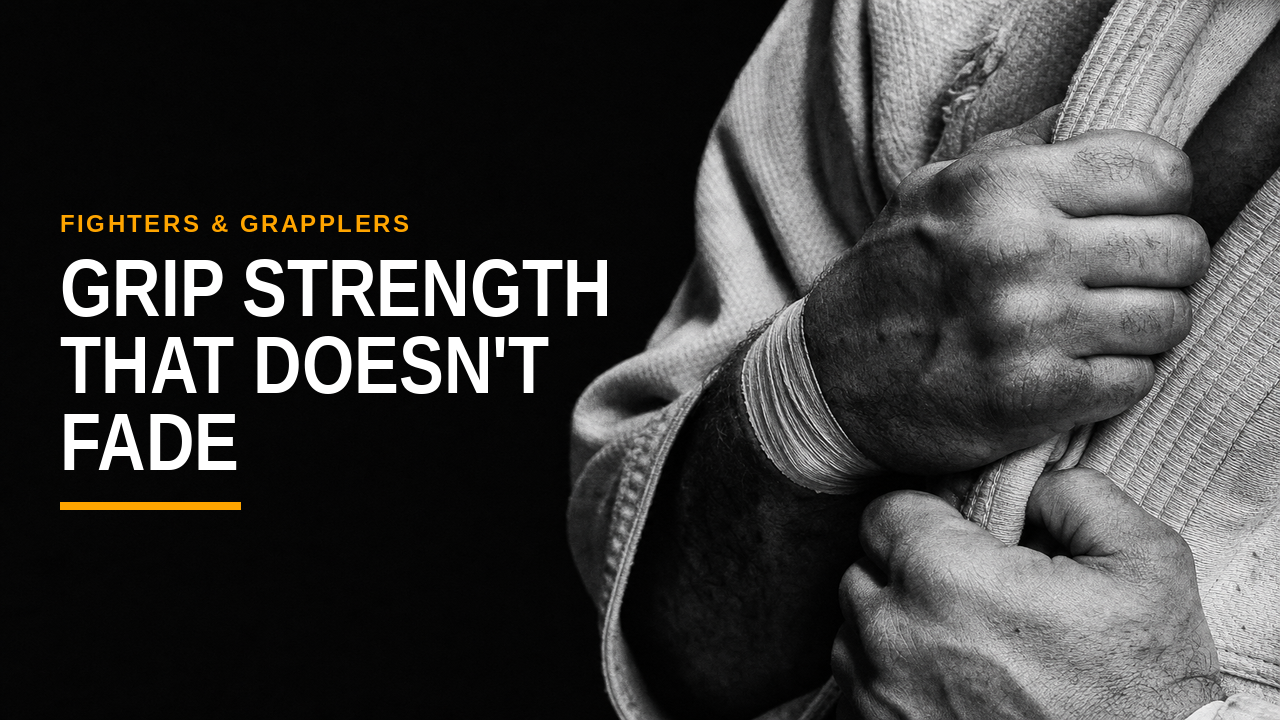
Build grip strength for fighting with carries, hangs, rows, towel work, pinching, and simple wrist work. Train the kind of grip you use in the room: hold hard, pull hard, control somebody, and keep your hands from quitting before the round is over.
Start with two short sessions a week after your main work. Pick a few movements, add a little time or load when the work looks clean, and do not turn forearm training into another workout that ruins tomorrow's practice.
Free: Get Iron Hands — the free grip training guide.
Why Grip Strength Carries Over to Fighting
Grip is not just a deadlift test. A big pull from the floor is fine, but the fight does not ask you to stand over a bar and squeeze for one rep. It asks you to keep contact while another person is pulling, twisting, sweating, changing levels, and trying to make you let go.
For grapplers and wrestlers, your hands help you win the first exchange. A good grip lets you keep a collar tie honest, hold a wrist long enough to get to your next move, finish a body lock, or make somebody work to clear your tie. For MMA, grip work supports the clinch, cage work, takedowns, and the ugly moments where you have to control a limb before you can do anything clean.
For boxers, the job is different but still real. The hand and wrist need to stay organized behind the glove, tolerate bag work and pad work, and avoid becoming the weak link when the rest of the body is ready to train. No hand exercise replaces good wraps, smart bag work, and a coach fixing bad punches. But stronger hands and forearms give you more room to train well.
The goal is useful strength. You should be able to grip, release, turn your hand over, open the hand, and show up to skill practice without your forearms feeling cooked. That is what carries over.
The Three Grip Jobs Worth Training
You do not need a dozen names for every hand position. Most useful grip work falls into three jobs. Train all three over time, then lean harder on the one your sport and your weak spot demand.
1. Crush Grip: Closing the Hand
Crush grip is your ability to close the hand hard around something. Think grippers, thick handles, towel rows, and grabbing a sleeve or wrist. It matters, but it is only one piece. A guy who can close a heavy gripper can still lose his hands in a long hard round if he never trains holds, carries, or open-hand work.
2. Support Grip: Holding On
Support grip is the workhorse. It is holding a kettlebell on a carry, hanging from a bar, carrying a sandbag, or keeping your hands on somebody through a scramble. This is where combat athletes usually get the most return. It teaches the hand to stay switched on while the rest of the body is working too.
3. Pinch Grip: Thumb Strength
Pinch grip is the thumb working against the fingers. Plate pinches, block holds, and pinching a folded towel build it. A stronger thumb helps you control odd shapes and gives the hand more options. Do not make it your whole plan, but do not ignore it either.
Wrist and Extensor Work: The Work Most People Skip
Your hand should not only close. It needs to open, move, and hold a solid wrist. Add finger extensions with a light band, wrist turns with a hammer or light dumbbell, and easy wrist curls or reverse wrist curls. These are not hero exercises. They are the boring work that helps keep the hand balanced when you do a lot of squeezing, pulling, punching, and gripping.
Simple rule: every session with hard gripping gets a little opening and wrist work. Two easy sets of finger extensions are cheap insurance against living with your hands closed all week.
The Grip Exercise Library
Pick movements you can load, repeat, and recover from. The list below is not a dare to do every exercise. Use it like a tool box.
Support Grip: Carries, Hangs, and Holds
- Farmer carry: Carry two heavy dumbbells, kettlebells, or trap-bar handles for 3–5 trips of 20–40 yards. Stand tall. Do not let the load pull your shoulders forward.
- Suitcase carry: Carry one weight on one side for 3–4 trips of 20–30 yards each side. This makes the hand work while the trunk resists getting pulled over.
- Bar hang: Hang from a pull-up bar for 3–5 holds of 15–40 seconds. Start with both hands. Use feet on the floor or a box if you need to build up.
- Towel hang: Put two towels over a bar and hang from the towels for 3–4 holds of 10–25 seconds. Great for grapplers, but hard enough that you should earn it.
- Deadlift top hold: After your final deadlift set, stand with the bar for 10–20 seconds. Use it only when your deadlift work is already clean and your hands are not beat up.
Crush Grip: Close and Control
- Grippers: 2–4 sets of 5–10 clean closes per hand. Use a level you can close without twisting your whole body or making your elbow angry.
- Towel rows: Wrap a towel around a cable handle or pull-up bar and row for 3–4 sets of 8–12. Keep the row honest; the towel is the grip challenge, not an excuse to turn the rep into a shrug.
- Thick-handle holds: Use a thick bar, a towel around a dumbbell handle, or fat grips for 3–4 holds of 15–30 seconds.
- Rope pulls: Pull a sled or loaded bag with a rope for 4–6 short trips. Keep the body position strong and let the hands work without turning it into a sloppy arm-only drill.
Pinch Grip: Build the Thumb
- Plate pinch: Pinch two smooth plates together and hold for 3–5 sets of 10–30 seconds each hand. Start light enough that the thumb stays in a good position.
- Block hold: Pick up a small wood block, pinch block, or the head of a light dumbbell and hold for 3–4 sets of 15–25 seconds.
- Pinch carry: Carry a plate or block at your side for 3 trips of 15–25 yards each hand. Slow and clean beats heavy and crooked.
Wrist, Hand, and Extensor Work
- Finger extensions: Open the fingers into a light band for 2–3 sets of 15–25. The last few reps should work, but the hand should not cramp.
- Hammer turns: Hold a hammer, light mace, or dumbbell end and slowly turn palm up, palm down, and thumb up for 2–3 sets of 8–12 each direction.
- Reverse wrist curls: Use a light dumbbell or bar for 2–3 sets of 12–20. Keep the motion slow.
- Wrist circles and open-close work: One or two easy minutes before bag work, pads, or grappling is plenty. This is preparation, not punishment.
How Grip Work Changes by Sport
Grappler / BJJ
Grapplers need long, patient support grip. Gi players can use towel hangs and towel rows because the material gives the hand a familiar problem. No-gi athletes still need the same base, but carries, hangs, rope pulls, and hard rows usually make more sense than trying to copy every sleeve grip in the gym. Use short crush work as an add-on, not the main event. If your elbows feel hot after rolling, drop the extra hard holds for a week and keep the easy finger-opening work.
Wrestler
Wrestlers need strong hands in ties, wrist control, front-headlock positions, and scrambles. Carries, rope pulls, bar hangs, and towel work fit the job. Do most of it after lifting, not before live work. During the season, one short grip finish per week can be enough when the room is hard. Grip belongs beside neck work and smart strength training, not on top of a pile of extra conditioning. For the bigger year-round plan, read Wrestling Strength and Conditioning: The Year-Round Guide.
Boxer: Wrist and Hand Health First
Boxers do not need a forearm contest. They need hands and wrists that can handle the work. Start with clean wrapping, smart bag volume, good punch mechanics, and enough recovery. Then add light hammer turns, finger extensions, reverse wrist curls, and carries. Save hard grippers and long hangs for days when the hands feel good. If a punch, bag session, or grip drill gives you sharp pain, stop trying to be tough and get it looked at. Training around a problem is not the same as pretending it is not there.
MMA
MMA athletes need a little of everything: holding a wrist, fighting in the clinch, changing levels, controlling on the fence, and protecting the hand through striking work. Build the base with carries and hangs, then use towel rows or rope pulls when you need more grip-specific work. The biggest mistake is adding a hard grip circuit after every MMA session. Your hands already work during pads, drilling, sparring, wrestling, and grappling. Put the extra work where it fits the week. For the bigger picture of building your whole fight engine, use the MMA Strength and Conditioning: The Complete Guide.
Grip Tools: The Honest Take
Grip tools are not magic. They are just tools. Grippers build your ability to close the hand. A thick handle makes a normal lift or carry harder to hold. Towel work gives you a rougher handle. Pinch blocks train the thumb. A rope gives you a way to pull and hold at the same time.
What they do not do is replace training. A gripper will not teach you to keep a collar tie, finish a takedown, or punch with a clean wrist. It can be useful if you use it in the right dose. The same goes for fancy tools. If you have dumbbells, kettlebells, a pull-up bar, towels, and a band, you already have enough to build serious hands.
The rock-climber crossover is worth understanding too. Climbers are good at making the fingers work for a long time on small holds. Borrow the patience and the attention to the hand, not every hard fingerboard routine. Combat athletes have enough stress on their elbows and fingers already. Build up slowly.
Programming Grip Without Wrecking Training
Grip work is assistance work. Your skill practice, main lifts, and recovery come first. Put grip work at the end of two strength sessions each week, or add a light hand-prep block before training. Keep one session more about holding and carrying, and the other more about pinching, wrist work, or grippers.
A simple starting dose is 10–15 minutes. That might be three carry trips, three hangs, and two sets of finger extensions. It does not need to smoke you to work. If you cannot grip a bar, make a fist, or comfortably shake hands the next day, you did too much.
Use the calendar: keep your harder grip work away from your hardest grappling, wrestling, bag, or sparring days. When the room volume goes up, cut the extra grip work down. The goal is better training, not a bigger forearm pump.
For a combat athlete lifting twice a week, use Session A after your lower-body or pull day and Session B after your other strength day. If you train skill five or six days a week, one hard session and one light wrist-and-extensor session may be all you need.
A Four-Week Grip Progression
Run this after two strength sessions per week. Leave a rep or a few seconds in the tank. If you are in a heavy week of sparring, live wrestling, or hard rolling, repeat the prior week instead of forcing the next jump.
| Week | Session A | Session B |
|---|---|---|
| 1 | Farmer carry: 3 x 20 yards Bar hang: 3 x 15 seconds Finger extensions: 2 x 20 |
Towel row: 3 x 8 Plate pinch: 3 x 10 seconds each hand Hammer turns: 2 x 10 each way |
| 2 | Farmer carry: 4 x 20 yards Bar hang: 3 x 20 seconds Finger extensions: 2 x 20 |
Towel row: 3 x 10 Plate pinch: 3 x 15 seconds each hand Hammer turns: 2 x 12 each way |
| 3 | Farmer carry: 4 x 25 yards Bar hang: 4 x 20 seconds Finger extensions: 3 x 20 |
Towel row: 4 x 8 Plate pinch: 4 x 15 seconds each hand Hammer turns: 3 x 10 each way |
| 4 | Farmer carry: 3 x 30 yards Bar hang: 3 x 25 seconds Finger extensions: 2 x 20 |
Towel row: 3 x 10 Plate pinch: 3 x 20 seconds each hand Hammer turns: 2 x 12 each way |
After week four, either add a little load, add a few seconds, or switch one movement. Do not add everything at once. A grip plan works best when it stays boring enough to run for months.
Common Grip Training Mistakes
- Only doing grippers: Closing the hand is useful, but fighters need carries, holds, thumb work, and open-hand work too.
- Training grip before practice: Do not show up to drilling with tired hands unless that is the specific point of the session. Most of the time, train it after.
- Using pain as a scorecard: A hard forearm pump is not proof of a good plan. Sharp pain, swollen fingers, or a cranky elbow are signals to back off and sort it out.
- Chasing fancy tools: A towel, a bar, a pair of dumbbells, and a band can cover most of the job.
- Forgetting the other side of the hand: Add extensions and easy wrist work. Hands that only squeeze eventually complain.
- Adding volume during hard camp: If wrestling practice, rolling, pads, and sparring are already high, maintain instead of trying to set a carry record.
Frequently Asked Questions
How often should fighters train grip?
Two short sessions a week works for most people. During a hard fight camp or heavy stretch in the room, one hard session plus easy hand prep is usually smarter.
What are the best grip exercises for BJJ and grappling?
Carries, hangs, towel rows, towel hangs, rope pulls, and finger extensions are a strong starting group. Gi athletes can use more towel work. No-gi athletes should still make support grip the base.
Do wrestlers need special grip work?
They need grip work that fits their season. Carries, hangs, rope pulls, and towel rows are plenty. In season, keep it short enough that it supports the room instead of taking away from it.
Can grip strengtheners help fighters?
Yes. They are a simple way to train closing strength. They are not a complete grip plan, and they should not cause elbow pain. Use clean reps, low volume, and pair them with carries or hangs plus finger extensions.
Will grip work help boxing hand and wrist health?
It can support it, especially light wrist turns, finger extensions, carries, and controlled wrist work. It does not replace good wrapping, smart bag work, clean punching, or getting a painful hand checked.
Should I use straps when I deadlift?
For most strength work, hold the bar yourself. If grip is the only thing stopping a planned heavy pull or a back-off set, straps can be a tool. Just do not let straps erase all of your holding work. Carries and holds can cover the gap.
Why do my elbows hurt when I train grip?
Usually the dose is too high, the tool is too hard, or the hand only closes and never opens. Cut the hard squeezing for a week, keep easy finger extensions and wrist movement, then build back slower. If pain sticks around or gets worse, get a qualified professional to look at it.
Can I build grip strength with no special equipment?
Yes. Use loaded carries, bar hangs, a towel over a pull-up bar, rows with a towel on the handle, and a light band for finger extensions. Start there before buying anything.
What to Do Next
Pick two support-grip movements, one pinch or crush movement, and one easy hand-opening drill. Run them twice a week for four weeks. Keep notes on the load, distance, or hold time. Then make a small jump and keep going.
Strong hands are built the same way as the rest of a capable body: useful work, repeated over time, without turning every session into a test.