
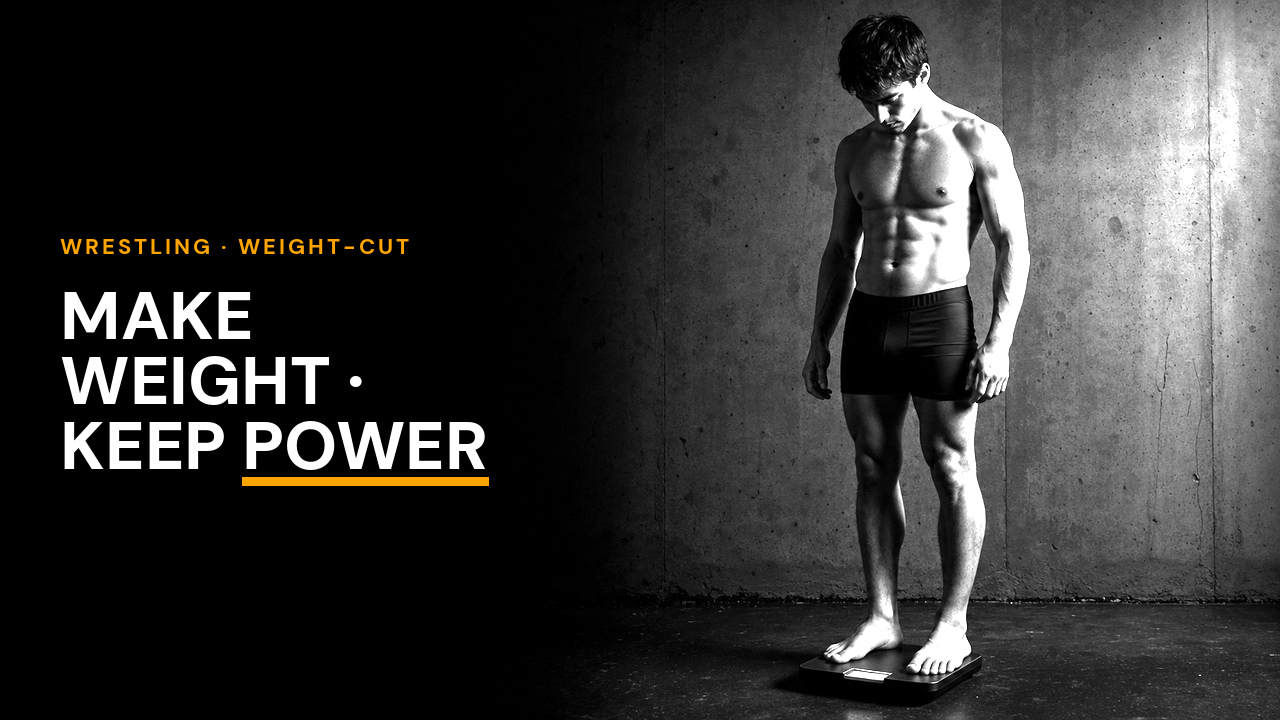
Cutting Weight for Wrestlers: The Right Way to Make Weight Without Wrecking Your Match
Jun 28, 2021Wrestlers cut weight. That's the reality of the sport. What separates wrestlers who compete well at their target weight from wrestlers who show up depleted, shaky, and slow on their feet is not if they cut — it's how, when, and how much.
Most wrestlers are doing it wrong. The classic pattern: eat normally for six weeks, panic in the last ten days, sit in a sauna suit riding a bike for an hour, cut water two days out, and step on the scale legally-weighed but physiologically wrecked. Then wonder why they get tossed in the second period.
There is a better way. This is the weight-cut framework we use inside THE PHYSICAL WRESTLER — one that protects strength, sleep, and gas tank while making weight cleanly. It's not fancy. It's not new. It's just done right.
The Complete Guide
Wrestling Strength & Conditioning — the year-round system
This post covers weight-cut strategy. For the full framework — off-season, pre-season, in-season, match prep, recovery — read Wrestling Strength & Conditioning: The Year-Round Guide.
The 3 Weight-Cut Mistakes That Wreck Wrestlers
Mistake 1: Cutting too much, too fast. A wrestler carrying 8-12% above match weight into the final two weeks is not going to cut cleanly. He's going to slash calories, water-load, sauna-suit, and show up depleted. Big cuts protect nothing — not strength, not skill, not the wrestler's health. The clean cuts start weeks earlier and stay under 6%.
Mistake 2: An hour of steady-state cardio in a sauna suit. This is the classic "I need to lose 3 pounds tonight" move — bike or run for 60 minutes at moderate pace to sweat. What actually happens: glycogen depletion, muscle protein breakdown, cortisol spike, sleep disruption, and a wrestler who feels weak the next day. Cardio sweats are not the tool. There are better ways to drop water.
Mistake 3: Cutting muscle instead of body fat. When a wrestler drops 15 pounds in 8 weeks and 8 of those pounds are muscle, he's a smaller version of himself with less strength, less power, and less repeat-effort capacity. Then he wonders why he can't finish a shot he finished easily in October. The scale went down but the wrestler got worse.
How Much Weight Should a Wrestler Actually Cut?
The number matters. Cutting the wrong amount, from the wrong starting point, is where most weight cuts break.
The 5% rule: A wrestler can cut up to 5% of body weight cleanly in the final 7 days using proper water manipulation and food volume reduction — without losing measurable strength or match-day performance. A 150-lb wrestler making 143 is doable. A 150-lb wrestler making 133 is not — that's a full 11% and it will cost him.
Beyond 5%: Everything above 5% needs to come off weeks earlier, through slow body-fat reduction — not through the final-week acute cut. If your walking-around weight is 165 and your target weight is 152, that's an 8% gap. Five of those percentage points come off across 6-8 weeks. The final 3% comes off in the last week using water manipulation.
Real numbers:
- Walking weight to target: gap under 5% → all comes off in the final 7 days.
- Gap 5-8% → cut half of it slowly across 4-6 weeks, the rest in the final week.
- Gap 8-12% → serious slow cut across 8-10 weeks, only the final 3-5% in the final week.
- Gap over 12% → wrong weight class. Move up. Compete healthy.
The Two Weight-Cut Phases
Phase 1: The Slow Cut (weeks 4-10 out)
This is where the fat comes off. Real fat, not water. The tools are simple:
- Modest caloric deficit — 300-500 calories under maintenance. Not 1,000. Not "1,200 calories a day." The wrestler is training hard; the fuel has to be there.
- Protein stays high — 1.0 to 1.2 grams per pound of body weight per day. Non-negotiable. Protein protects muscle in a deficit.
- Carbs stay moderate — 1.5 to 2.5 grams per pound. Wrestlers need carbs for mat work. Slashing them is how strength and power vanish.
- Fat fills the gap — 0.3 to 0.5 grams per pound. Nuts, olive oil, avocado, whole eggs, fatty fish.
- Aerobic base stays in — 2-3 zone 2 sessions per week supports fat loss without stealing recovery.
Target rate: 0.5 to 1.0 pound of fat loss per week. Slower is better than faster. Faster means muscle is coming off too.
Phase 2: The Acute Cut (final 7 days)
Now the wrestler is within 5% of match weight going into the final week. This is where technique matters most.
- Days 7-4: Water-load. Drink 1.5-2 gallons per day. This maximizes urine output and primes the body to shed water when intake drops.
- Days 3-2: Reduce water gradually. 1 gallon on day 3, half gallon on day 2. Cut sodium sharply. Reduce carb volume moderately (not zero — the wrestler still needs mat energy).
- Day 1 (day before weigh-ins): Sip only. 8-16 ounces total across the day. No sodium. Low-residue foods only if hungry — protein and a small amount of carbs.
- Morning of weigh-ins: No fluid, no food. Empty bladder and bowels. If still 1-2 lbs over: a short 15-minute walk to warm up and sweat lightly is enough. No sauna suit marathons.
This protocol pulls 3-5% of body weight cleanly in the final week for most wrestlers. Any more than that and the acute cut becomes damaging.
Sweat Sessions Done Right (When Needed)
If a wrestler is still 1-3 pounds over on day 1 or the morning of weigh-ins, a short sweat session can pull the last of it. The key is short and non-depleting. Old-school hour-on-the-bike sweats destroy glycogen and cause a slow-motion crash on match day.
The clean sweat protocol:
- Warm up 5 minutes at easy pace to raise core temperature.
- Pick a full-body movement that produces heat without heavy leg loading — versa-climber, moderate hill walk, rower at conversational pace, or heavy bag combinations.
- Work moderate — sweat should come from body temperature, not maximum effort. Muscle burn is the wrong signal. You should be able to hold the same pace for 20 minutes.
- Session length: 15-25 minutes max. Not an hour. Not two.
- Stop when the target is hit. If it takes longer than 25 minutes, the pre-cut wasn't done right — solve that problem next time, don't solve it now by grinding for another hour.
Alternating short bursts with a partner (as in the old Carmen Bott protocol) can work — 20 seconds moderate work, 20 seconds rest, cycling back and forth across two exercises for 15-20 minutes. The trick is to not hit muscle burn. If your quads are pumping, the intensity is too high and glycogen is coming off with the water.
The Post-Weigh-In Refuel
The window between weigh-in and match is often 12-24 hours. This is where a smart wrestler out-competes the wrestler who just made weight and passed out at the pizza buffet.
First 60 minutes after weigh-in: Rehydrate. Not chug — sip. Water plus electrolytes (sodium, potassium, magnesium). 20-24 ounces over the first hour.
Hours 1-3: Small easy-to-digest meal. Rice, chicken or fish, a fruit. Continue fluids at a moderate rate — 8-12 ounces every 30 minutes.
Hours 3-6: Second small meal. Same profile — moderate protein, easy carbs, minimal fat. Keep sipping fluids.
The night before matches: Normal dinner. Not a feast. The wrestler wants to feel full but not stuffed. Continue steady fluid intake but taper it in the last 90 minutes before bed.
Match-day morning: Standard pre-match breakfast — 2-3 hours before the first match. Oatmeal, banana, honey, a little protein. Sip fluids up to 60 minutes before the match, then stop.
What NOT to Do During the Cut
- Not sauna suits for 90 minutes. Old school. Wrecks glycogen and hurts the wrestler more than it helps.
- Not cutting more than 3 pounds in the final 24 hours. The body needs water more than one match's worth of scale weight.
- Not diuretics or laxatives. Banned in most orgs, dangerous everywhere, and they pull electrolytes with the water. Cramping and cardiac risk go up sharply.
- Not skipping meals for a week. Chronic under-eating in the final week torches strength, mood, and match performance. Small meals through the week, targeted cuts in the final 72 hours.
- Not lifting heavy in the last 3 days. Nervous-system fatigue lingers. Maintenance-level movement, mobility, and light sport work only.
Weight Cutting for Different Age Groups
High school wrestlers: The 5% ceiling is even more important. Younger athletes have less resilience, are usually still growing, and lose more strength per pound cut. Keep the gap under 5% and cut mostly through slow body-composition changes weeks out.
College & open-level wrestlers: Can handle slightly larger cuts (up to 7% with proper protocol) but pay a real cost above 5%. Most successful college programs cap cuts closer to 4%.
Masters/veteran wrestlers: Slower recovery, less glycogen storage capacity, and more sensitivity to dehydration. Cap cuts at 3-4%. If the walking-around weight is more than that above target, drop a class.
Frequently Asked Questions
How far out should I start cutting weight?
Depends on the gap. Under 5%: start the acute cut 7 days out. 5-8% gap: start slow body-comp work 4-6 weeks out. 8-12% gap: 8-10 weeks out. Above 12%: reconsider the weight class. Slow cuts protect strength and skill; fast cuts destroy them.
Can I lift while cutting weight?
Yes, and you should — but volume drops. During the slow-cut phase, one to two short heavy sessions per week is enough to maintain strength. In the final 3-5 days, drop lifting entirely and let the nervous system rest. Come back to the barbell after the tournament.
Do sauna suits work?
They pull water. They also cook the wrestler. A short 10-15 minute sauna suit session as a final adjustment can be fine. An hour of cardio in a sauna suit is a fast track to depletion, cramping, and a bad match. Use the tool sparingly and only when the pre-cut is otherwise on track.
Should I still eat carbs while cutting?
Yes. Wrestlers need carbs for mat energy and for glycogen storage. Slashing carbs to zero during a cut kills strength and reaction time. Moderate carb intake (1.5-2.5 g/lb during slow cut) and a small carb window post-weigh-in are how you keep the wrestler fueled.
How much water do I drink the day before weigh-ins?
Somewhere between 8 and 16 ounces total, sipped across the day. Not zero. The kidneys need enough throughput to keep flushing water without triggering aggressive retention. The exact amount depends on the wrestler's sweat rate, current weight vs target, and how much water they were carrying entering the day.
How Weight-Cutting Fits the Bigger Framework
Weight management is a year-round game, not a two-week sprint. Wrestlers who make weight cleanly stay close to match weight through the year, cut body fat slowly in pre-season, and use the final-week protocol only for a small controlled water manipulation. That approach protects the wrestler's off-season strength, conditioning, and match-day power.
See the full year-round framework in the pillar guide for how weight-cut integrates with everything else.
The Bottom Line
Weight cutting for wrestlers is a slow game with a fast finish. Body fat comes off across 4-10 weeks in a modest deficit while protein stays high. The final 3-5% of water comes off in the final 7 days using controlled water manipulation. Sauna suits and hour-long cardio sessions are the wrong tool — they destroy the wrestler you spent months building.
The wrestlers who dominate their weight class aren't the ones who cut the most weight the hardest. They're the ones who cut a little weight the right way, and show up on match day fresh, strong, and hydrated enough to compete for a full six minutes.
Make weight without wrecking your match.
Grab the free Wrestler Strength Map — the wrestler's field manual for building strength, gas tank, and neck durability that lasts six rounds. Or go all-in with THE PHYSICAL WRESTLER, our year-round wrestling strength and conditioning system built around your season — off-season, pre-season, in-season, weight-cut — not on top of it.
Get the Free Wrestler Strength MapGet THE PHYSICAL WRESTLERTrain year-round. Own the mat.