
Best Exercises for MMA Conditioning: 14 Moves for Fighters
Jun 21, 2021Ask a fighter what they want more of and the answer is almost always the same: better conditioning. But conditioning isn't a single exercise — it's a stack of the right movements, done at the right intensity, in the right order.
This is the short list. If you're building a conditioning program for MMA, these are the exercises that actually earn their spot in the week.
Start with the full framework: MMA Strength and Conditioning: The Complete Guide.
Why exercise selection matters more than volume
Most conditioning programs fail because the exercises don't match the demands of a fight. Random burpees and jumping jacks make you tired — they don't make you a better fighter. The best exercises for MMA conditioning do three things at once:
- Load the same movement patterns you use in the cage (hinging, driving, pulling, carrying, rotating)
- Train an energy system that shows up in a fight (base engine, repeat power, or grind)
- Build resilience in the joints and tissues that get hammered on the mat
Everything below hits at least two of the three. The best hit all three.
The strength side — six patterns, six exercises
Before you can condition a fighter, you need something worth conditioning. That means real strength in the six big patterns. One primary exercise per pattern, one to two sessions a week, kept heavy and short.
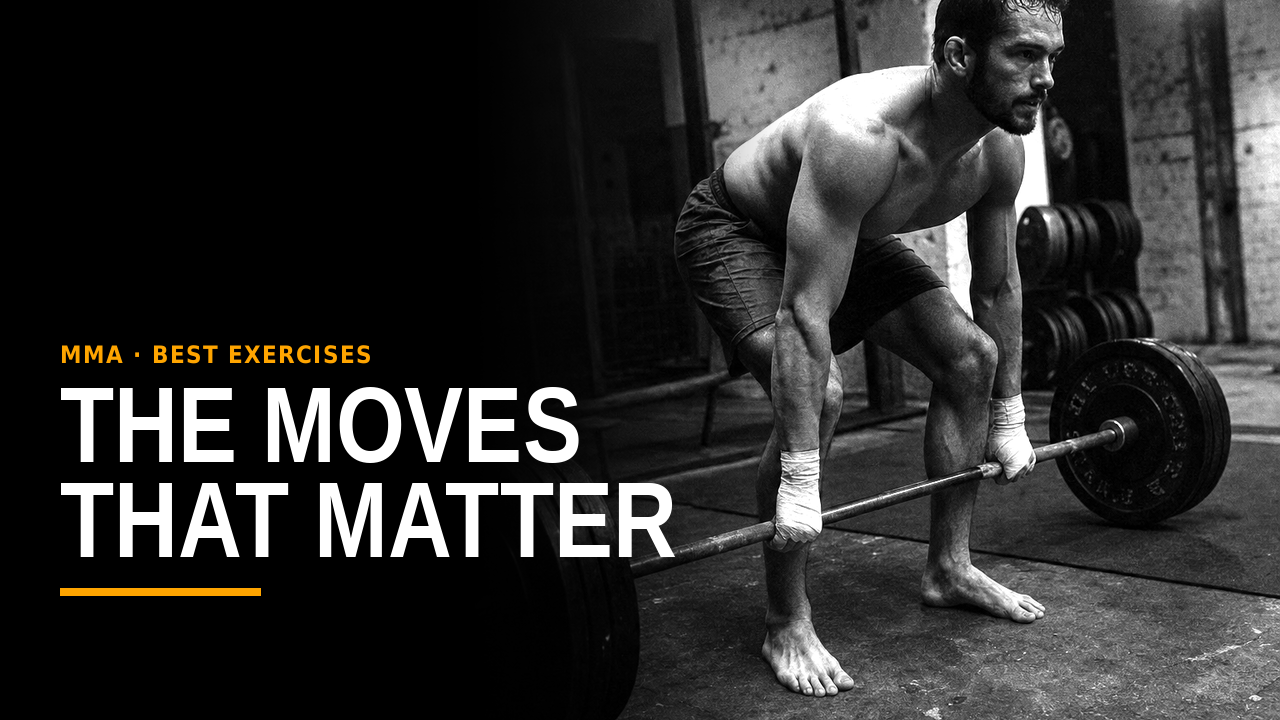
1. Hinge — Trap-Bar Deadlift
The single best strength exercise for a combat athlete. Loads the posterior chain hard, spares the low back compared to a straight bar, and transfers directly to shooting takedowns, sprawling, and driving off the cage.
2. Squat — Front Squat or Goblet Squat
Front-loaded squats force an upright torso and hammer the trunk. If you can't hold the rack position, start with goblet squats. Both patterns build leg strength that survives a five-round fight.
3. Lunge — Reverse Lunge or Split Squat
Single-leg strength is where most fighters are weakest. Reverse lunges load the working leg hard without wrecking the knees. Progress to rear-foot-elevated split squats when body-weight versions get easy.
4. Push — Overhead Press or Push-Up Variant
Standing overhead press builds real shoulder strength and trains the trunk to brace under load. When shoulders are cranky, sub in heavy push-ups — feet elevated, hands on kettlebells, weighted with a vest.
5. Pull — Weighted Chin-Up and Heavy Row
Pulling strength is grip, back, and rotational anchor all at once. Every fighter should be able to do bodyweight chin-ups for reps and add load from there. Pair with a heavy row variant — single-arm dumbbell rows, chest-supported rows, or inverted rows with a vest.
6. Carry — Heavy Farmer Carry
Grip, trunk, hip stability, and grind capacity in one exercise. Pick up two heavy dumbbells or kettlebells and walk. Farmer carries expose weakness fast — if you can't hold on for 30 seconds, that's the fight you'll lose late in a round.
The conditioning side — three energy systems, three exercise types
7. Base Engine — Long Bag Rounds, Shadowboxing, and Jump Rope
For the aerobic base, you don't need fancy equipment. 30–60 minutes at a moderate pace, heart rate 130–150 bpm, 2–3 times a week. Long bag rounds at 50–60%, shadowboxing with intent, or jump rope for time. This is the foundation everything else sits on.
8. Repeat Power — Hill Sprints and Sled Pushes
Short, hard, repeatable. 10–30 seconds all-out, 60–90 seconds easy, 6–10 rounds. Hill sprints teach explosive drive. Sled pushes overload the same pattern with less impact on the joints. Both build the "burst" your gas tank actually needs.
9. Grind Capacity — Kettlebell Complexes and Positional Wrestling
2–5 minutes of continuous hard work, 2–3 minutes rest, 3–5 rounds. Long kettlebell complexes (clean → squat → press → lunge → row, unbroken) or live positional wrestling rounds. This is the ugly work that lets you hold top position or push the pace in round three.
The connective tissue — five that punch above their weight
10. Kettlebell Swing
A hinge, a power output, and a lung-burner all at once. Sets of 20–30 with a heavy bell trains the exact hip snap you need to drive through a takedown or generate rotational power in a punch.
11. Turkish Get-Up
The single best full-body movement quality drill. Trains bracing, shoulder stability, and the ability to organize the body under load. One or two heavy get-ups per side is enough as part of a warm-up.
12. Sledgehammer Rotational Work
Standing rotational strikes into a tire train the exact hip-to-shoulder power transfer you use to throw a hook or drive an elbow. 20–30 second sets, alternate sides, 4–6 rounds.
13. Sandbag Get-Up and Bear Hug Carry
Ugly, awkward, and closer to fighting than any barbell exercise. Wrestling with a sandbag builds grip, trunk, and the ability to move a resisting load — which is exactly what an opponent is.
14. Sprints — Straight and Change of Direction
Real speed still matters. 6–10 short sprints (10–40m), full recovery between each. Adds change-of-direction work once the straight-line speed is there. Sprints keep the nervous system sharp when heavy strength work would just add fatigue.
Free Fighter Resource
Build Your Gas Tank Without Random Punishment
Get the Fighter’s Conditioning Starter Kit: seven practical sessions to help you build capacity, repeat power, and better training structure.
Get the Free Fighter’s Conditioning Starter KitHow to program it in a week
You don't do all of these every week. You pick the right ones for the phase you're in.
- Build phase (8+ weeks out from a fight): Strength 2x, base engine 2–3x, repeat power 1x, one grind day per week
- Fight camp (4–8 weeks out): Strength 2x lighter, base engine 1–2x, repeat power 1–2x, grind day 1x, sport-specific work dominates
- Taper (fight week): One short strength session early in the week, one light bag day, mobility and recovery from there
Two strength sessions a week. One or two conditioning sessions per system. The rest is skill work, sparring, and recovery. That's the whole program.
The mistake to avoid
Doing all fourteen exercises in a random order every week is not a program — it's a mess. Pick one primary lift per pattern and one conditioning method per system, run it for four to six weeks, then rotate. Consistency beats variety every single time.
Related reading: the three types of cardio every fighter needs — the energy-system breakdown that decides how many rounds you can push.
Build the full fighter system: cardio for MMA · kettlebell workouts for MMA and BJJ · MMA plyometrics.
Ready for a real system?
STOP GUESSING. START TRAINING.
THE PHYSICAL FIGHTER gives MMA athletes a clear strength, conditioning, and recovery structure that fits around skill work and fight camp.
Get THE PHYSICAL FIGHTERNEXT READ: bodyweight MMA conditioning.