
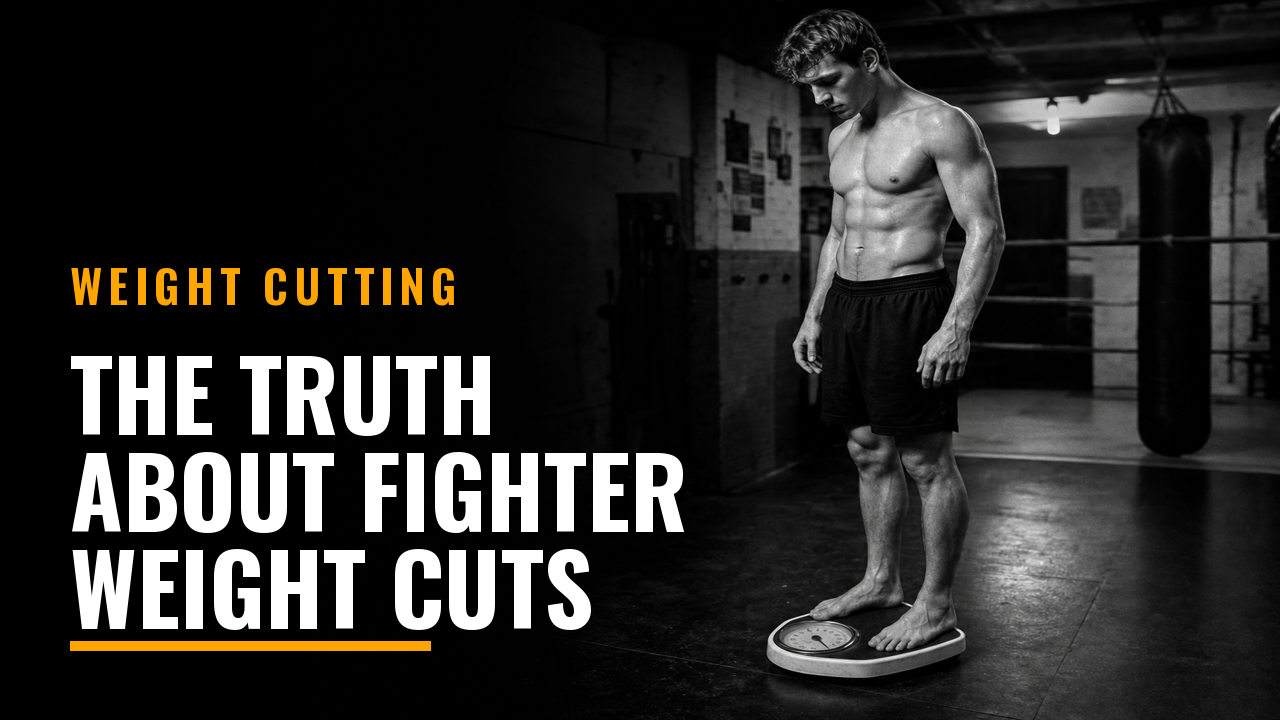
Why Do Fighters Cut So Much Weight?
Jun 29, 2021Updated July 2026
2026 Coach's Note: Since we first published this, the conversation around weight cutting has shifted hard. Between USADA's post-2023 exit, new state athletic commission hydration checks, and the rise of longer fight-week weigh-ins, fighters have more tools than ever to cut smarter. But the core answer to why do fighters cut weight hasn't changed: it's a size-and-leverage arms race. The athletes who win it long-term are the ones who build the strength and conditioning base first, then use nutrition to trim, not to survive. — Corey
By Corey Beasley — Founder & Head Coach, PHYSICAL. 20+ years developing strength and conditioning for fighters, grapplers, and combat athletes.
Every fighter you watch on Saturday night walked into the cage 10 to 25 pounds lighter than they walked around the gym on Monday. That's not an accident. It's a strategy — and depending on who's doing it, it's either the smartest edge in the sport or the fastest way to lose a fight you should have won.
Weight cutting isn't unique to MMA. Wrestlers cut. Boxers cut. Grapplers cut. But MMA fighters cut the most — often 15 to 20% of their body weight in the days before weigh-in. There's a reason for that. Actually, there are three.
The Short Answer
Fighters cut weight to weigh in at a lower class, then rehydrate before the fight so they step into the cage bigger, stronger, and denser than an opponent who cut less. It comes down to three things: tradition, a competitive mass advantage, and matching a shorter frame to the right class. The catch — the cut is only worth it if you can rebuild fast. Below is exactly how it works, how much they cut, whether it is safe, and what the smartest fighters do instead.
Reason 1: Tradition
"My coach did it. His coach did it. The guys who came before me did it. So I do it too."
That's the answer most fighters give if you ask them why they're standing on a scale looking dead-eyed in a sauna suit at 3 a.m. It's not strategy. It's inheritance.
Combat sports have a deep, silent culture of "the cut is just what you do." Nobody sat down and engineered it. It became the norm because everyone did it, and everyone did it because it became the norm. This is appeal-to-tradition thinking — and while tradition isn't always wrong, it isn't always right either.
The problem: if you're cutting weight only because everyone else does, you're inheriting the risks without earning the reward. The reward is a real thing (we'll get to it in a second). But you have to know why you're cutting or you're just wrecking yourself for a habit.
Reason 2: Competitive Advantage
This is the real one. Cut weight properly and you walk into the cage heavier, stronger, and denser than the guy you're standing across from. He made 155 lbs at weigh-in same as you — but you rehydrated to 175 lbs by fight night. He rehydrated to 162 lbs. That 13-pound gap shows up in every clinch, every takedown, every ground exchange.
Body mass matters more the more your sport rewards imposing yourself on someone else. This is why the pattern is so clean across combat sports:
- Grapplers, wrestlers, and MMA fighters cut the most weight. Their sport is about getting your body onto your opponent's body and forcing outcomes. More mass wins.
- Boxers and pure strikers cut less. Speed, cardio, and technical volume matter more than mass. A boxer who cuts too hard trades speed for size and it's a bad trade.
In MMA specifically — grappling, clinch, fence work, striking, ground game — you're imposing your body weight in every phase. That's why MMA has the deepest, most aggressive weight-cutting culture in combat sports. The fighter who lands at their walking-around weight and has the same skill level as their opponent generally wins.
Bottom line: the cut is a strength strategy disguised as a weight strategy. You're not making weight — you're making bigger you than the guy across from you.
Reason 3: Undersized for the Class Above
Height matters. Frame matters. A 5'9" fighter walking around at 200 pounds could fight at light heavyweight (205), but they're going to be short, stubby, and matched against 6'2" opponents with more reach and leverage. The math doesn't work in their favor.
That fighter would be better off cutting to middleweight (185) or even welterweight (170) where their frame is average or above average for the class. This is the smart cut — not for competitive edge, but for structural fit.
You'll rarely see 5'9" fighters at heavyweight. You'll rarely see 6'4" fighters at bantamweight. There's a reason: the sport self-selects for frame within a class. When you're on the wrong side of that self-selection, cutting down is often the right move.
The three reasons together:
- Tradition — you inherit the practice
- Competitive advantage — you exploit mass differential
- Structural fit — you match your frame to the class
Most fighters cut for some combination of all three. The smartest fighters know exactly which one is driving their cut, and they cut accordingly.
What Smart Fighters Do Instead
Here's what nobody in the transcript-style articles about weight cutting will tell you: the cut is only as good as the rebuild.
If you strip 20 pounds in fight week and can't put it back on properly, you show up gassed, slow, and dehydrated. Your competitive advantage evaporates. Your speed drops. Your reaction time drops. Your grip strength drops. You're fighting yourself before you fight him.
The smartest fighters don't just cut hard — they train specifically to survive the cut and rebuild fast. That means:
- A big, deep aerobic base so their engine still runs after the depletion phase. Weight-cut recovery is aerobic recovery.
- Grinding strength under fatigue, not just fresh maxes. A dehydrated fighter is a fatigued fighter. Train the way you'll fight.
- Repeat-power capacity — the ability to throw a hard shot in round three the same way you did in round one, after you've been depleted and rehydrated.
- A conditioning progression that runs toward fight week, not one that peaks four weeks out and leaves you spinning your wheels while cutting.
If you're going to cut, cut smart. And build a body that can handle the cut — not one that gets destroyed by it.
The Cut Is Different in Every Sport
Here is the mistake that wrecks more athletes than any sauna suit: copying a cutting plan from a sport that weighs in on a completely different schedule. The single biggest factor is not your sport — it is how much time sits between the scale and your first fight. A day-before weigh-in gives you hours to rebuild. A same-day weigh-in does not. That one difference changes how much you can safely take off and how you put it back.
| Sport | Typical weigh-in | Safer cut range* | Rebuild window |
|---|---|---|---|
| MMA | Day before (24–36 hr) | ≤ 8% of body weight, 10% hard cap | Full overnight rebuild |
| Boxing | Day before (pro); tighter for amateur | ≤ 8% of body weight, 10% hard cap | Overnight, protect speed |
| Wrestling | Same day + consecutive days | 2–4% of body weight, 5% hard cap | Short & urgent; plus certified min weight + hydration test |
| Grappling / BJJ | Varies — identify first (IBJJF same-day vs ADCC day-before) | Same-day 2–4% (cap 5%); day-before 6–8% (cap 10%) | Depends entirely on format |
*These are conservative coaching guardrails for the final fight-week adjustment, not a target to chase. The exact water-loading math and full dehydration protocol are individual and belong with a qualified coach — not a copy-and-paste routine. Percentages are ceilings; the smallest cut that lets you perform is always the right one.
Because the schedule and the demands change so much between sports, we built a free one-page reverse-countdown handout for each one — plus a deeper guide for how to make weight in your specific sport without giving away performance:
- How Much Weight Do MMA Fighters Cut? — the day-before cut and 24-hour rebuild
- Boxing Weight Cut: Keep Your Strength and Snap — making the class without losing speed and power
- How to Cut Weight for Wrestling Safely — same-day and multi-day tournaments, certified minimum weight
- The Art of Weight Cutting in BJJ — why you must identify your weigh-in format first
Weight Cutting FAQ
Why do UFC and MMA fighters cut the most weight?
Because MMA rewards imposing your body weight in every phase — grappling, clinch, fence work, and the ground game. A mass advantage pays off constantly, so MMA and wrestling built the deepest, most aggressive cutting culture in combat sports. Pure boxers cut less: for them, cutting too hard trades away the speed and cardio the sport actually rewards.
How much weight do fighters cut?
Commonly 10 to 25 pounds — often 15 to 20% of body weight — in the days before weigh-in. The bulk of it is water manipulated during fight week and rehydrated afterward, not fat loss. For the actual numbers by weight class, see How Much Weight Do MMA Fighters Cut?
Why do fighters cut weight right before a fight?
Weigh-ins usually happen 24 to 36 hours before the fight. That gap is the whole game: fighters drop water weight to hit the number on the scale, then spend the next day and a half rehydrating and refueling so they step in heavier, fuller, and stronger than they weighed in.
Why do wrestlers cut weight?
Same core logic as MMA: wrestling is about controlling and forcing outcomes on another body, so more mass at match time wins exchanges. Wrestling arguably started the modern cutting culture — and it is where a lot of fighters first learned to do it, for better and worse.
Is cutting weight safe?
A moderate, well-planned cut with proper rehydration can be done safely. Aggressive water cuts are a different story — dehydration, cramping, kidney strain, and a body too depleted to fight are all on the table. The rule that keeps you safe is the same one that keeps you competitive: the cut is only as good as the rebuild. Build the engine and the grinding strength to survive it before you ever step on the scale.
Build the gas tank fighters actually need.
Start with the free Fighter's Conditioning Starter Kit — 7 sessions you can run this week to build real fight-specific engine. Or step into THE PHYSICAL FIGHTER, our 12-week program built around round-five conditioning, strength that transfers, and durability that holds up to fight camp.
Get the Free Fighter's Conditioning Starter KitGet THE PHYSICAL FIGHTERTrain hard. Recover harder. Fight longer.
Cut weight the right way for your sport:
- How Much Weight Do MMA Fighters Cut? — day-before cut, actual numbers by class
- Boxing Weight Cut: Keep Your Strength and Snap
- How to Cut Weight for Wrestling Safely
- The Art of Weight Cutting in BJJ
- How to Choose Your MMA Weight Class
Build the engine that survives the cut: