
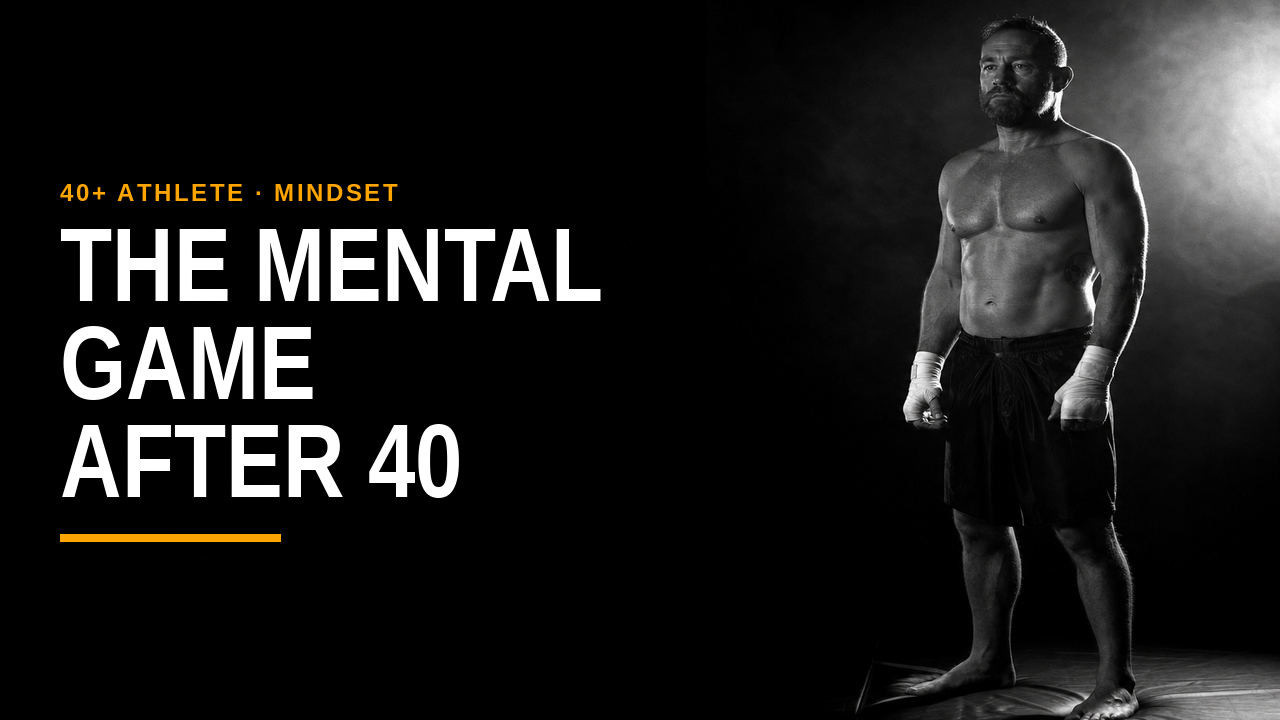
The Mental Game of Training After 40
Jun 15, 2024The hardest adjustment after 40 is not physical. It is stopping using your younger self as the daily benchmark. Every session measured against a 25-year-old who does not exist anymore is a session you lose before you start.
This is the part nobody programs. You can fix the training — the full method is in the guide to training after 40 for combat athletes — and still spend every week losing to a ghost. Ego, comparison, guilt about backing off, and the quiet question of why you are still doing this at all. That is what this page is about.
You Are Competing With A Ghost
Everybody over 40 carries a highlight reel. The camp where you felt bulletproof. The version of you who trained twice a day, slept badly, ate whatever was in the fridge, and still turned up sharp.
That guy is the benchmark you are quietly using, and the comparison is rigged. He had a recovery window you no longer have, he had none of your injury history, and he did not have your job, your kids, or your mortgage sitting on top of the training. You are not a worse athlete than him. You are a different athlete with a different set of inputs, being graded on his scale.
Every session measured against a 25-year-old who does not exist anymore is a session you lose before you start.
And the comparison does not just make you feel bad. It makes you train badly. If the standard is what you could do at 25, then every sensible adjustment reads as decline, so you refuse to make it — and you keep running a plan built for someone with twice your recovery. The ghost does not just cost you your mood. It costs you the training decisions that would actually make you better.
You are not falling apart. You are running the wrong program for where you actually are.
Toughness Is Your Best Trait And Your Biggest Liability
Combat athletes are rewarded for toughness from the first week. You get respect for finishing the round, for not complaining, for coming back tomorrow. That trait is why you lasted long enough to be reading an article about training after 40.
It turns dangerous at exactly the point where sensible adjustments start to feel like weakness. Because now the same instinct that carried you tells you not to shorten the session, not to sit a round out, not to say the shoulder is talking to you again.
Look at how the pressure actually stacks up in a gym. The athlete pushes because he does not want to disappoint the coach. The coach pushes because that is what was done to him. Nobody in the room is acting in bad faith, and everybody mistakes exhaustion for commitment. The loudest measure of a session becomes how wrecked everyone was at the end of it.
Here is the reframe that matters: grinding is a tool. It is not a permanent operating system. You use it in the block where it belongs, on the day you can absorb it, for a purpose you can name. Running it every session for a decade is not toughness — it is the absence of a plan.
The Signals You Are Grading Yourself Wrong
This one is easy to check. These are the tells, and most 40-plus athletes will recognise at least three of them.
| What you do now | What it actually is | The replacement |
|---|---|---|
| You respond to fatigue by adding effort | Treating a load problem as a character problem | Ask what the week is asking of you before you add anything to it |
| You feel guilty when you reduce the workload | Confusing volume with virtue | A planned lighter day is part of the program, not a failure of one |
| You judge the day by how much you survived | Measuring damage instead of progress | Judge it by what improved — a load, a position, a round you controlled |
| You treat every flat day as a test of character | Ignoring information your body is handing you free | Lower the ceiling, keep the floor, leave better than you arrived |
| You keep pushing because stopping feels like weakness | Identity doing the job that planning should do | Decide the adjustment in advance, so it is a rule and not a surrender |
The right-hand column is the whole mental shift. Not softer training — a different scoreboard. Written rules make adjustments feel like execution instead of retreat, which is why the readiness rule and the weekly structure in the 40+ training guide do as much for your head as they do for your joints.
The Ego Cost Of Tapping And Of Saying No
Two moments cost 40-plus athletes more training time than any program error: the tap you delayed, and the round you did not decline.
The late tap is pure arithmetic. Your ego gets an extra half-second. Your shoulder pays for six months. Nobody in the room remembers who tapped on Tuesday. You will remember the year you could not press overhead.
Declining a round is harder, because it is public and it happens before anything has gone wrong. The 22-year-old who treats every roll like a final asks if you want to go. You are already three hard rounds in, your grip is done, and you say yes anyway — not because you want the round, but because saying no in front of the room feels like admitting something.
You are allowed to choose your partners and your rounds. Not every round has to be a test. The guys still training at 55 are not the ones who never said no — they are the ones who got comfortable saying it early, and who play a game built on position, grips and timing rather than a game that needs a scramble.
Reframe it once and it stops stinging: tapping early and picking your rounds are not concessions to age. They are the price of admission for training next week, next month and next year. Nothing you protect today is lost. It is banked.
Redefine What Winning A Session Means
Most of the guilt disappears the moment you change what you are scoring. If a good session means you got destroyed, you will get destroyed until you get injured. If a good session means something improved, you have a scoreboard you can win on for the next twenty years.
A won session at 45 looks like this:
- A load moved cleanly that did not move cleanly a month ago — with reps still in the tank at the end of it.
- A position you held that you used to lose, or a grip you kept in round three.
- You showed up on a flat day and trained the day you were in rather than the day the page said you should be having.
- You finished able to train again the day after tomorrow. Tomorrow's session is part of today's score.
- Nothing new hurts. That is a result, not a neutral outcome.
Notice that none of those are about beating a 25-year-old, and none of them are soft. Get better, not just tired.
Motivation Fades. Discipline Lasts.
At 25, motivation was cheap. A highlight video and a bad night's sleep and you were in the gym at six. At 45 you have a job that drains you, a family that needs you, and a body that does not hand out free enthusiasm at five in the morning. If you are waiting to feel motivated, you will train about eleven times this year.
Discipline is what does not need a feeling. Two structured sessions a week that happen whether or not you are excited about them beat five sessions a week that depend on your mood, because the two-day-a-week guy is still training in March. Consistency is the variable that actually separates 40-plus athletes, and it is almost never the one they try to fix.
The practical version is unglamorous. Fix the days. Keep the floor when life gets messy — shorter session, two or three important movements, a walk, some mobility, regular meals. The goal in a bad week is not a perfect week. It is keeping the rhythm without digging the hole deeper.
Starting combat sports late, or coming back after years away? The head game is different again — read From Fan to Fighter: a beginner's guide to combat sports in your 30s and 40s.
Train For The Next Decade, Not Today's Score
Ask yourself the honest question: what do you want to be doing at 60? If the answer is still rolling, still lifting, still stepping on the mat when you feel like it, then every training decision has a simple test. Does this move me toward that, or does it borrow from it?
That test resolves almost everything. The extra hard round when you are already cooked borrows. The taper before a masters competition invests. The grinding max attempt borrows. The three-second lowering phase on a lighter weight invests. Once the horizon is a decade instead of a Tuesday, the choices stop being about pride and start being obvious.
This is also the honest answer to why you still train. Not legacy, mostly. Not a medal you will keep in a drawer. You train because a body that moves well and feels strong makes every other part of your life better, and because the gym and the mat are where you are still fully yourself. You are not chasing a six-week transformation. You are building a body that keeps doing what you love for another twenty years.
You do not stop training because you age. You age better because you train.
Nobody hands out points for how hard the last ten years were. Show up, do the work, recover on purpose, repeat.
When The Rut Breaks
I was bored and stuck in a rut at the big-box gym, but Corey gave me purpose, pushed me, and helped me hit my goals. Now I'm leaner, stronger, and more motivated than ever.
Shad
Age 42
Frequently Asked Questions
How do I stop comparing myself to my younger self?
Change what you measure. Your younger self had a recovery window you no longer have, no injury history, and none of your current life load, so the comparison is rigged before you start. Score the session on what improved instead — a load that moved cleanly, a position you held, the fact that you can train again in two days.
Why do I feel guilty when I train less?
Because combat sports reward toughness, and after enough years volume starts feeling like virtue. The guilt shows up when you judge a day by how much you survived rather than what improved. Planned lighter days are part of the program, not a failure of it — and writing the adjustment down in advance makes it feel like execution rather than surrender.
Is it weak to decline a round or tap early?
No. It is the price of admission for training next month. A late tap trades half a second of ego for six months of shoulder, and a round you took only because saying no felt public is the round that most often costs you time off the mat. Choose your partners, choose your rounds, and play a game built on position and timing rather than scrambles.
How do I stay motivated to train in my 40s and 50s?
Stop relying on motivation. It fades — discipline lasts. Fix two or three sessions in the week that happen regardless of mood, and keep a floor for bad weeks: a shorter session, two or three important movements, a walk, some mobility. The guy training twice a week in January is still training in June. The guy training five times on enthusiasm usually is not.
Why do older grapplers keep competing at all?
Because it gives the training a point, and because the mat is where a lot of us are most ourselves. The useful version of that motivation looks forward rather than backward: not defending what you were at 25, but building a body that keeps doing what you love for another twenty years. Every training decision gets tested against that horizon.
Free guide
You're not broken. You're buried.
THE 40+ COMEBACK is a free guide to the three basics that dig you out — no fluff, no 5am ice baths, no 22-year-old influencer nonsense. Train hard enough to grow, light enough to recover.
Get the free 40+ Comeback Guide →
Written by a coach programming for combat athletes since 1998.
Keep Reading
- Training After 40 for Combat Athletes — the complete method, week by week
- From Fan to Fighter — starting combat sports in your 30s or 40s
- Strength Training After 40: A Master's Guide — the programming detail
- What Actually Slows Down As You Age — the physiology, plainly
Written by Corey Beasley, founder of PHYSICAL and strength and conditioning coach who has worked with combat athletes since 1998 — from UFC veterans and professional grapplers to masters competitors and everyday athletes who just want to keep training. Train smart, fight hard.