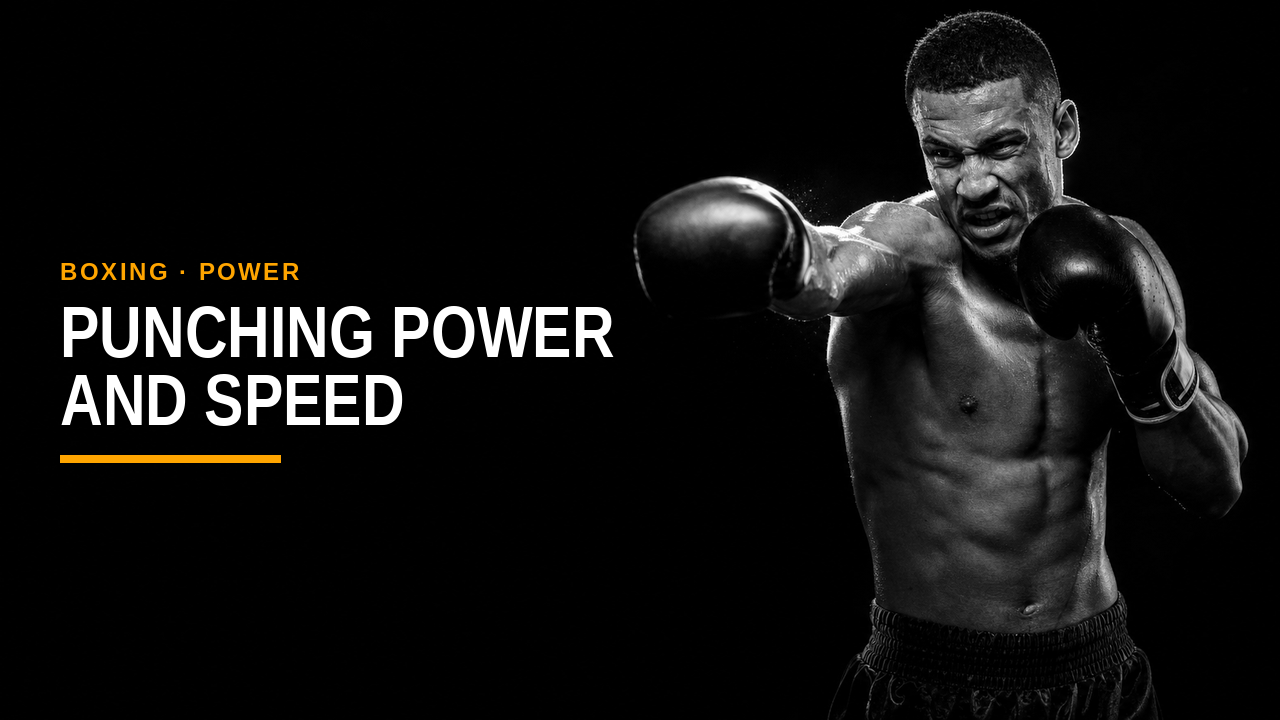
Maximizing Punching Power and Speed: A Boxer’s Guide
Feb 11, 2023Better punching power and speed come from force moving cleanly from the floor through your legs, trunk, shoulder, and fist. Get stronger, learn to put that strength into the punch, and build a gas tank that lets your mechanics stay together when the round gets hard. There is no magic drill. Good punching is built through skill, smart strength work, and consistent rounds.
Start with the full framework
This article covers one piece of the picture. For the full 8-week plan that turns strength into a harder punch, read How to Train Your Punching Power: The 8-Week Plan. For how movement, conditioning, strength, power, and fight-camp load fit together for a boxer, read Boxing Strength and Conditioning: The Complete Guide.
Power Starts At The Floor
A punch is not an arm exercise. Your fist is the last thing in the chain, not the engine. You push into the floor, organize the leg and hip, turn the trunk, and let the shoulder and arm carry that force into the target.
That is why a guy with smaller arms can still hit you like a truck. He is not trying to muscle the glove from the shoulder. He is connected from the floor up and arrives balanced enough to put his weight into the shot.
Research on a straight punch has looked at how momentum moves through the arm segments into a target. That supports the practical coaching point: force has to travel somewhere. If your stance leaks, your hip comes late, or your wrist folds, you lose what you built before the punch ever lands (Journal of Sports Sciences).
Build The Base Before You Chase Speed
Strength training belongs in a boxer’s week because a stronger athlete has more to work with. It does not turn a bad puncher into a good one by itself. It gives the legs, trunk, and upper body a better foundation to repeat good work.
- Train the legs. Squat patterns, split squats, hinges, and step-ups teach you to push into the floor and hold position.
- Train the trunk. Carries, controlled rotation, and anti-rotation work help you transfer force without twisting yourself loose.
- Train the upper body. Rows, presses, pull-ups, and push-ups build the structure around the shoulder. Keep the work honest and keep your shoulder healthy.
- Train one leg at a time. Boxing is full of shifting weight, stepping, and landing. Single-leg work helps you own those positions.
Do not turn every lift into a speed contest. First earn positions you can control. Then move lighter loads with intent. A fast rep that looks like a yard sale does not teach you much.
Free Download
Grab The Boxer's Training Rules Cheat Sheet — the free one-page guide to training around your boxing, not against it. No cost.
Send It To MeUse Fast Work Without Getting Cute
Jumps, medicine-ball throws, and short, crisp push-up variations can be useful when they fit the athlete. The goal is not to collect exercises. The goal is to practice producing force quickly while you are still fresh enough to own the movement.
In junior amateur boxers, both an eight-week plyometric program and a jump-rope program improved rate of force development, punch reaction time, and rear-leg peak ground reaction force. The useful takeaway is not that one drill is magic. It is that well-run work over time can move qualities that matter to punching (Frontiers in Bioengineering and Biotechnology).
There is a reason to stay honest here. A smaller study of experienced amateur boxers found a mixed result from weighted plyometric training: single-punch force and punch frequency did not change, apart from one rear-hand low-punch measure. That is not proof that plyos add big power. It is a reminder to use the tool, test it in your boxing, and keep doing the work that transfers (Journal of Sports Medicine and Physical Fitness).
Technique Is The Transfer
Spend time on the bag, pads, and controlled sparring with a reason for each round. Work a clean rear hand after a step. Work the jab without reaching. Work a hook where your feet are under you instead of falling across the line. Film a few rounds and look at your balance after the punch, not just the moment it lands.
Speed is not flailing. Speed is knowing where you are going, staying loose until impact, and getting back to a position where you can punch again or defend yourself. The best way to get faster is to remove wasted movement and practice the same clean pattern enough times that it shows up under pressure.
Your Gas Tank Protects Your Power
If your legs are gone, the punch changes. A study in highly trained boxers found that fatiguing lower-body exercise reduced punch force. That fits what every coach sees late in hard rounds: the feet stop talking to the hips, the stance gets tall, and the arm starts doing a job meant for the whole body (European Journal of Sport Science).
Conditioning for a boxer is not just about surviving a hard run. It is about being able to sit down on a shot, recover your feet, and make the next good decision when you are breathing hard. Use bag rounds, pads, footwork, intervals, and sparring that reflect the work you need to hold up for.
A Simple Weekly Approach
- Keep your boxing practice at the center. Skill is the thing you are trying to improve.
- Use a couple of strength sessions to build the legs, trunk, and upper body without trashing your sparring.
- Add fast work in small doses while you are fresh. Stop before it turns sloppy.
- Use conditioning that makes you keep your stance and your hands when you are tired.
- Pay attention to your hands, elbows, shoulders, and low back. Pain is not a toughness test.
Bottom Line
There is no secret study that gives you a devastating punch. Get strong from the ground up. Practice transferring that strength through real boxing. Build enough work capacity to keep your mechanics when the fight gets ugly. Do that for a long time and you will give yourself a better chance to hit hard and hit fast.
Build A Punch That Holds Up
Start with the free The Boxer's Training Rules Cheat Sheet — the free one-page guide to training around your boxing, not against it. Or step into The PHYSICAL Boxer, the full strength and conditioning system built around the demands of the ring.
Get The Free Cheat SheetSee The PHYSICAL BoxerReferences
- “Transfer of momentum from different arm segments to a light movable target during a straight punch.” https://pubmed.ncbi.nlm.nih.gov/24404907/
- “A Comparison of Plyometric and Jump Rope Training Programs for Improving Punching Performance in Junior Amateur Boxers.” https://pubmed.ncbi.nlm.nih.gov/35685089/
- “Effects of plyometric exercise training with external weights on punching ability of experienced amateur boxers.” https://pubmed.ncbi.nlm.nih.gov/27623756/
- “The effect of fatiguing lower-body exercise on punch forces in highly-trained boxers.” https://pubmed.ncbi.nlm.nih.gov/33858296/