Takedown Defense Starts With Posture: The Muscles That Hold It
Apr 14, 2024Getting taken down is usually not a technique problem in the moment it happens. It is a posture problem that started three seconds earlier. If your opponent can break your posture, your technique never gets a chance to work — and holding posture against someone driving into you is a strength quality, not a skill you can drill your way into.
This is about the specific muscles that hold posture under load, why they fail, and how to train them.
This is the strength side of takedown defense and offense. For the whole training system it sits inside, see the BJJ strength and conditioning guide.
What Breaking Posture Actually Is
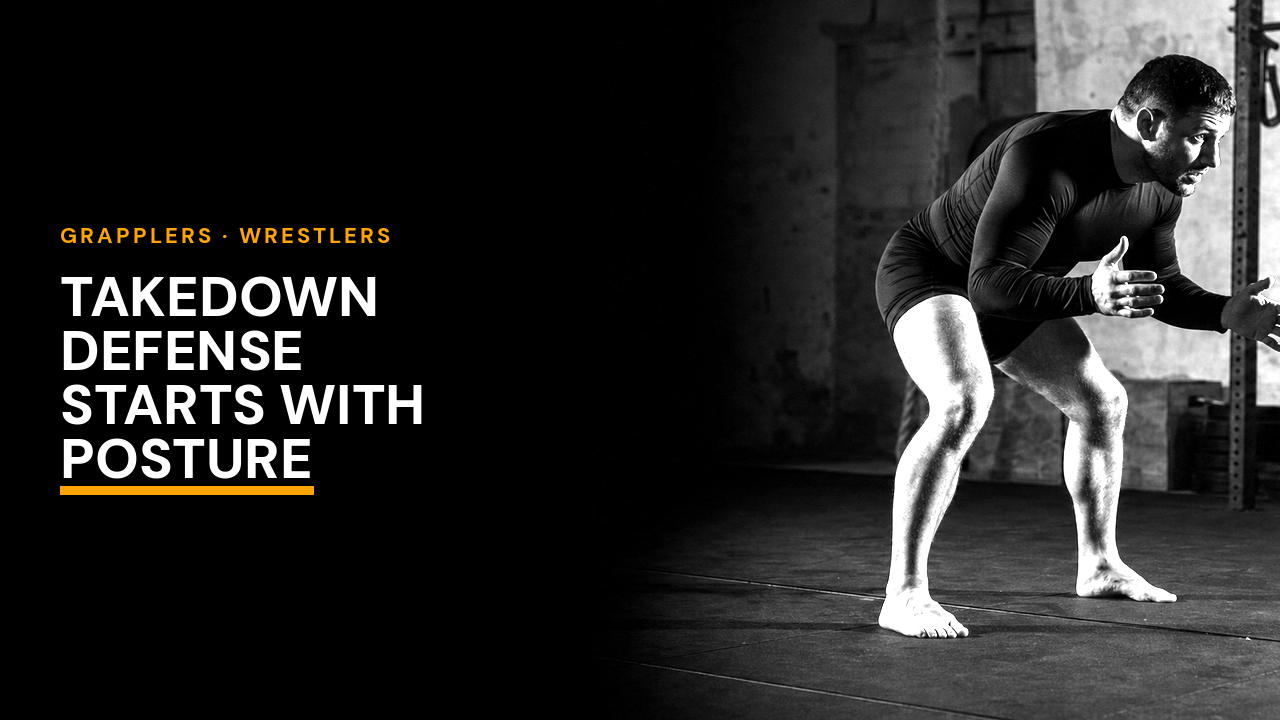
When someone shoots on you or drives a body lock, they are trying to do three things: get your head down, get your hips back and behind your feet, and get your weight onto your toes. Once those three things happen, you are going down regardless of how much you know.
Resisting it means holding a hinge under load with your head up and your hips underneath you, while someone is actively trying to fold you. The muscles that do that are specific and trainable.
The Muscles That Hold Posture
| Muscle group | What it does in a takedown exchange | How to train it |
|---|---|---|
| Upper back and traps | Keeps your head and chest up when someone drives on you | Rows, shrugs, dead hangs, face pulls |
| Neck extensors | Resists the cross-face and the head being driven down | Isometric neck extension, banded neck work |
| Glutes and hamstrings | Holds the hinge, drives your hips back under you | Deadlifts, good mornings, hip thrusts, single-leg work |
| Adductors | Stops your legs being separated, closes the guard, sprawls | Copenhagen holds, adduction work, wide-stance squats |
| Trunk (anti-flexion) | Stops you being folded forward | Loaded carries, planks under load, ab wheel |
| Grip and forearms | Every defensive tie and every finish | Loaded holds, thick-bar work, gi grip work |
The Training That Transfers
Isometrics First
A takedown exchange is largely isometric — you are holding a position against force, not moving through a range. That makes isometric training the most specific strength work a grappler can do for posture. Hold a hinge position under load. Hold a hard row position. Hold a sprawl.
Then Loaded Hinges
The hinge is the position. Train it heavy and train it under fatigue. Banded Zercher good mornings are the single most useful movement here — the load pulls you into exactly the position you are trying to resist.
Then Carries
Loaded carries teach your trunk and upper back to hold posture while your legs work and your breathing goes to hell. That is a takedown scramble in a nutshell.
A Simple Posture Block
TWICE A WEEK, 30 MINUTES
Zercher or banded good morning — 4 × 5, heavy but clean
Heavy row of any kind — 4 × 6–8
Isometric hinge hold under load — 3 × 20 sec
Loaded carry — 4 × 40 metres, heavy
Neck isometrics — 2 × 30 sec each direction
Copenhagen or adductor hold — 2 × 20 sec each side
Run this alongside your mat work, not instead of it. The demos for every movement are in the movement library. If your grip is the thing failing in ties, the grip protocol is the more urgent fix.
Why This Is Also A Durability Issue
The same muscles that hold posture are the ones that get hurt when they cannot. A neck that cannot resist a cross-face gets strained. Hamstrings that cannot hold a hinge get pulled in a scramble. Training posture strength is takedown defense and injury prevention at the same time — see staying on the mat.
Common Questions
Strong enough to hold a hinge under someone else's bodyweight for several seconds while breathing hard. In gym terms, a bodyweight-plus deadlift and a solid row usually gets you there. No. Technique wins. But strength is what buys you the time to apply it, and it is the piece most grapplers neglect entirely. Six to eight weeks of consistent posture work is enough to feel harder to move. The isometrics show up fastest. Sprawls are fine conditioning but they are not posture strength. Loaded hinges and holds build the quality; sprawls express it. It matters more than most people think, because the cross-face is the first attack on your posture. The full protocol is in the neck and upper back piece.How strong do I need to be to defend takedowns?
Is this more important than technique?
How long until I notice a difference?
Should I train sprawls as conditioning?
What about the neck specifically?
Hands that hold on when the rest of you is done.
Start with the free Grappler’s Iron Hands 14-day challenge — hands, wrists, and forearms built to keep their grip deep into a hard roll. Or step into THE PHYSICAL GRAPPLER, built around mat-specific strength, grip, and conditioning.
Start Iron Hands FreeGet THE PHYSICAL GRAPPLERGrip last. Win late.