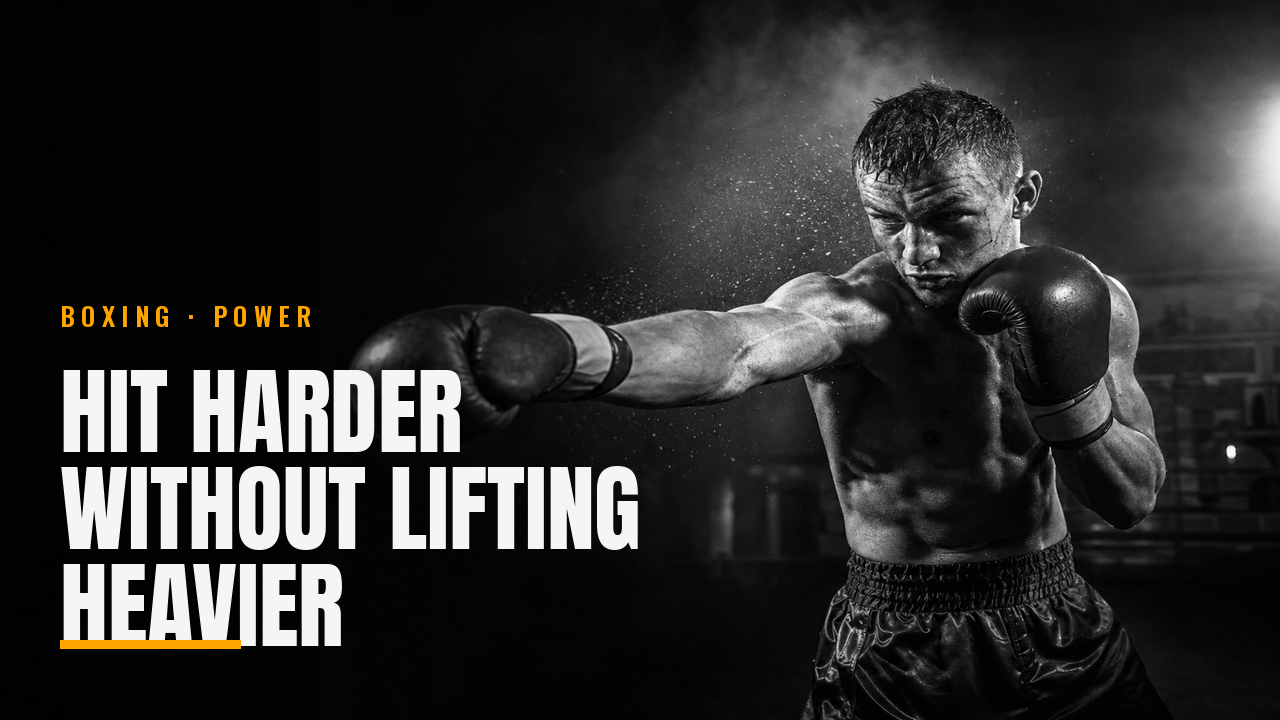
Hit Harder Without Lifting Heavier: The Truth About Power for Strikers
Jun 14, 2026Punching power doesn't come from your bench press. If it did, the strongest guys in the gym would be the hardest hitters. They're not.
Power is one of the most misunderstood qualities in combat sports. Fighters chase a bigger max lift thinking it'll translate to a bigger shot. Then they get in the ring and the guy who can't out-lift them puts them on the canvas. Strength matters — but raw strength isn't the same thing as the explosive, fast force that ends fights.
We've all seen it. The lean guy who doesn't look like much suddenly drops someone twice as muscular with a shot that came out of nowhere. That's not magic and it's not just genetics. It's a trained quality — the ability to deliver force fast — and it's almost always the thing separating the heavy hitters from the gym-strong guys who punch like they're pushing a door open. The good news: it's trainable. Once you understand what power actually is, you can build it on purpose instead of hoping a bigger bench eventually shows up in your hands.
The Problem: Confusing Strength With Power
Strength is how much force you can produce. Power is how fast you can produce it. A punch, a takedown, a blast double — these all happen in a fraction of a second. You don't have time to grind out force the way you do under a heavy barbell. You have to deliver it now.
This is where the concept of rate of force development comes in — how quickly you can turn force on. Two fighters can have the exact same max strength, but the one who can express that force faster hits harder, moves quicker, and scores first. Every time.
Most strikers get this backwards. They spend all their time getting strong and almost no time learning to be fast and explosive with that strength. So they build a big, slow engine and wonder why it doesn't translate to the ring. The strength is real. The ability to use it fast was never trained.
And it cuts the other way too. Some fighters skip strength entirely — all speed, no foundation — and they hit fast but light, because there's no force behind the speed. Power needs both ingredients: enough strength to have something to deliver, and enough speed to deliver it before the target can react or brace. Lopsided in either direction and you leave knockout power on the table. The fighters who hit like a truck have trained both, in the right order, on purpose.
The PHYSICAL Take: Power Is Strength Expressed Fast
Here's the principle: you build a strength base, then you teach your body to express it explosively. You don't skip the base — strength is the raw material. But strength alone is unfinished. Power is what happens when you train that strength to fire fast.
In the PHYSICAL Performance Pyramid, this is Tier 4 — quickness, agility, and power. It sits on top of your strength foundation, not in place of it. The fighters who hit hardest aren't always the strongest in the room. They're the ones who've trained their nervous system to deliver force in an instant, through the hips, through the chain, into the target.
A heavy hand is built. It's a trainable quality. And it's not built by chasing one-rep maxes.
This is why the strongest guy in the gym isn't the hardest hitter. Maximum strength is produced slowly — you grind a heavy bar up over a second or two. A punch lands in a fraction of that. By the time a pure powerlifter's muscles "turn on," the punch is already over. The fighter who has trained his nervous system to recruit force instantly delivers far more of his strength into the target in that tiny window. Same strength on paper, completely different result on impact. That instant turn-on is the quality you're after, and it has a name: rate of force development.
What To Do: Train for Speed of Force
1. Build a real strength base first.
You can't express power you don't have. A foundation of strength — squats, hinges, presses, pulls — gives you the raw force to work with. You don't need to be a powerlifter. You need to be solidly strong, then move on. Strength is the prerequisite, not the goal.
2. Train explosive intent.
Once you have a base, the key is intent — moving lighter loads as fast as humanly possible. Medicine ball throws, jumps, explosive landmine work, and ballistic movements teach your body to fire fast. The weight comes down so the speed can go up. This is where rate of force development actually gets trained.
Intent is the whole game here. The exact same exercise done lazily builds almost nothing; done with violent, maximal speed it rewires how fast your body recruits force. A medicine ball isn't heavy — the point is to throw it like you mean to put it through the wall. Every rep is a max-effort speed effort, not a max-effort grind. That's how you teach the nervous system the one thing a heavy barbell can't: to turn force on now, all at once, the way a knockout shot demands.
3. Train the hips and the rotation.
Punching power doesn't start in the arm. It starts in the ground, drives through the hips, and rotates through the core. Rotational power work — med ball throws, landmine rotations, anti-rotation strength — builds the chain that actually delivers a strike. A strong, fast, rotational core is the difference between an arm punch and a fight-ender.
4. Respect the nervous system.
Power work is high-quality, low-fatigue work. You train it fresh, not exhausted. A few sharp, explosive reps with full recovery beat 50 sloppy ones. Grinding power work into the ground turns it into conditioning — and kills the exact quality you're trying to build. Quality over quantity, every time.
This trips up combat athletes more than anything, because the culture says more is better and tired equals worth it. Not with power. The moment your throws slow down or your jumps get flat, the session is over — you're now training fatigue, not speed. Power is built in the sharp reps, the fast reps, the ones that look explosive. Put this work early in your session when you're fresh, keep the reps low and crisp, and rest enough that every single one is as fast as the first. Save the lung-burning work for your conditioning. Mix them up and you'll be mediocre at both.
The Bottom Line
The goal was never to lift the heaviest weight in the gym. The goal is to land the hardest, fastest shot when it counts. Those are different qualities and they're trained differently.
Build your strength. Then teach it to move fast. Power is strength expressed fast — and it's the quality that separates the fighter who scores first from the one who gets caught.
You don't have to be the strongest person in the room. You have to be the most dangerous — the one who can put real force on a target faster than the other guy can deal with it. That's a built quality, trained in the right order: a solid strength base, then explosive intent, then power driven through the hips and rotation, all kept fresh and sharp. Do that and the heavy hand stops being something you're born with and starts being something you own.
Develop the explosive power that lets you strike fast and score first.
Grab the free Boxer Training Rules Cheat Sheet — the rules that keep boxers fast, fresh, and durable all fight. Or step into THE PHYSICAL BOXER or THE PHYSICAL FIGHTER, our 12-week programs built for speed, repeatable power, and a gas tank that lasts every round.
Get the Free Boxer Training Rules Cheat SheetGet THE PHYSICAL BOXER / THE PHYSICAL FIGHTEROur training isn't about looking fit — it's about being dangerous.