Zercher Squats for MMA: Benefits, Setup and Trade-Offs
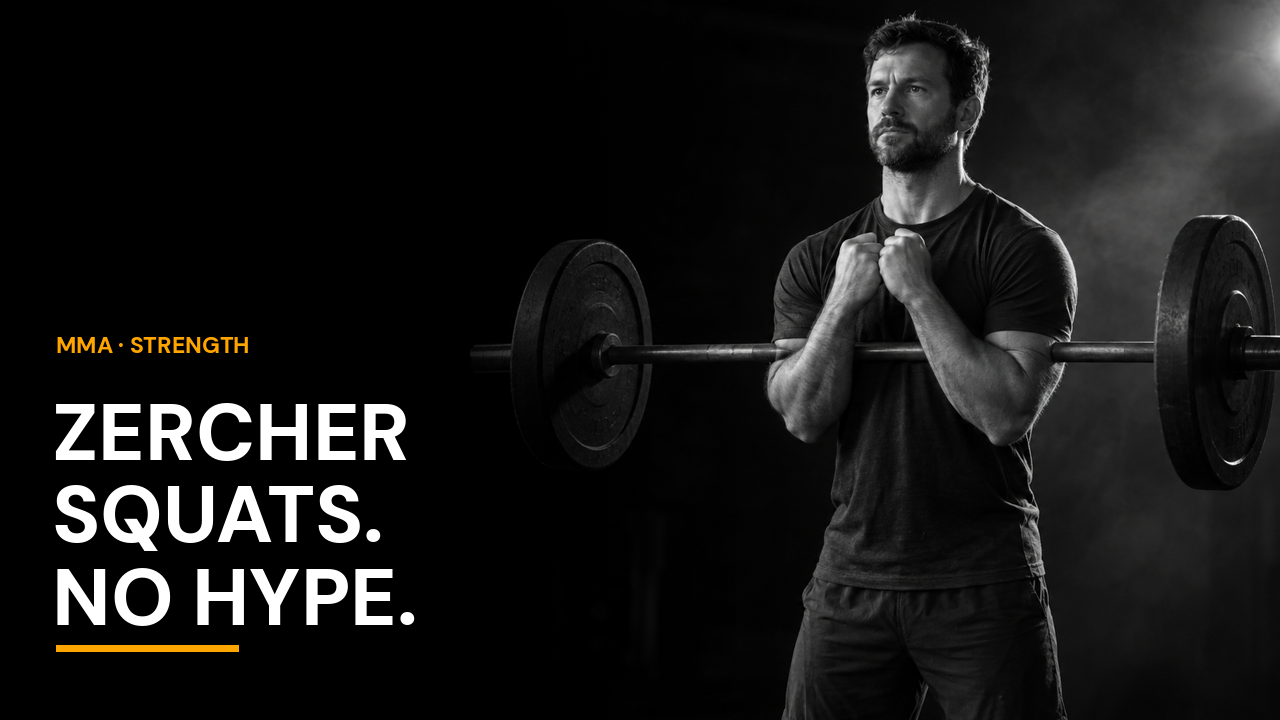
Jun 28, 2021The Zercher squat places the bar in the crooks of your elbows rather than on your shoulders. For an MMA athlete, it can be one way to train a front-loaded squat, but it is not automatically better than a back squat, a front squat or a simpler variation.
The useful question is whether you can perform it comfortably, load it progressively and recover well enough for practice. A lift does not become essential because a professional fighter has used it.
What makes the Zercher squat different?
The defining feature is the front-loaded elbow position. You have to support the bar while squatting, so the hold itself can become a limiting factor. That may make the exercise useful for one athlete and unnecessarily awkward for another.
PHYSICAL's coaching rationale is straightforward: it provides another option for training a squat while controlling a load in front of the body. That is a reason to consider it, not evidence that it produces superior takedowns, punching power or injury protection.
How to set up a Zercher squat
- Start from a rack: set the bar at a height that lets you get underneath it and stand without an awkward floor pickup. Use rack safeties appropriate to your squat depth.
- Begin light: learn where the bar sits in the elbow creases before adding meaningful weight. An unloaded bar may still be too much for a beginner; a simpler front-loaded squat is a valid alternative.
- Establish the hold: keep the load close enough to control it. Choose a comfortable hand position without treating one grip as mandatory.
- Use a controlled range: squat only as far as you can maintain a stable, repeatable position. Do not chase depth by collapsing into the bottom.
- Finish deliberately: stand, return to the rack and end the set under control. Learn the exit before attempting a demanding set.
These are general setup notes, not a substitute for seeing the movement coached in person. If the rack, bar or support position does not fit you, choose a different exercise.
Elbow discomfort is not a toughness test
Do not force your way through pain, numbness or tingling in order to keep the bar in place. Stop and change the exercise; persistent or concerning symptoms warrant professional assessment.
Padding changes the contact with the bar, but it does not make every load or position appropriate. If the hold limits the session before the legs receive useful work, a goblet squat, front squat or another tolerated option may serve the goal better.
What the fighter video does and does not show
The original article included this training clip as an example of a fighter using the variation. It is retained as an illustration, not as an endorsement of PHYSICAL or proof that the lift is superior.
Copying the visible exercise leaves out the rest of the athlete's program, training history and recovery. Use a demonstration to understand the movement, not to borrow a professional athlete's presumed prescription.
Where it belongs in your program
Our recommendation is to learn the Zercher squat while fresh and keep the initial dose modest. Use it as a deliberate strength exercise, not an unfamiliar movement buried at the end of a fatigue circuit.
- Define the reason: know what this variation offers your training that a simpler option does not.
- Track the same setup: record the load, repetitions, range and comfort of the hold.
- Progress only when repeatable: add load or repetitions when the current work is controlled and well tolerated.
- Keep sport practice central: reduce the gym demand when hard rounds, competition or poor recovery require it.
A good exercise should earn its place. If the main result is sore arms and worse practice, do not keep it simply because it looks fight-specific. Use our MMA strength and conditioning framework to put exercise selection in context.
Common questions
Are Zercher squats good for MMA?
They can be a useful squat option when the athlete tolerates the hold and the exercise fits the plan. They are not required, and exercise choice alone does not establish sport transfer.
Are they safer than back squats?
There is no universal safety ranking that makes this decision for you. Consider the athlete, technique, load, equipment and symptoms rather than treating the bar position as a guarantee.
Do I need to lift the bar from the floor?
No. Starting from a properly set rack is our preferred learning setup. A floor pickup introduces an additional task that is not necessary to practice the squat.
READY TO TRAIN LIKE THIS?
Put the principle into practice.
Choose exercises inside a plan rather than collecting fighter workouts. The PHYSICAL Fighter is our 12-week MMA strength and conditioning program with two primary sessions per week.
Get The PHYSICAL FighterGet better, not just tired.
Coaching real people since 1998.