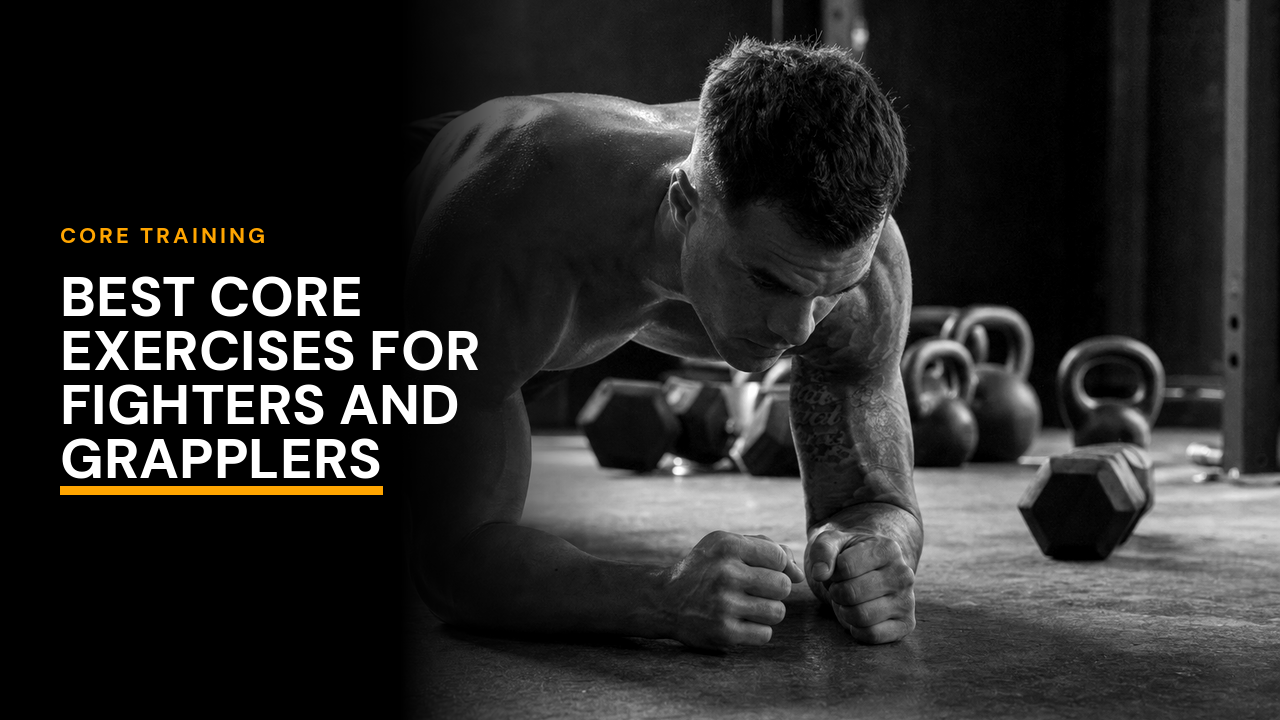
Best Core Exercises for Fighters and Grapplers: The 8 That Transfer
Jun 27, 2021This is one piece of a bigger topic. Read the full guide: Core Training for MMA: The 4 Jobs Every Fighter’s Core Must Do.
by Funk Roberts
The core muscles are those around your trunk (abs and obliques) as well those in your pelvis, hips and lumbar region. Many workouts fail to engage the core and without a workout designed to specifically target the core the muscles will weaken over
 This can cause pain, especially if muscle is being built elsewhere. Although core exercises shouldn’t necessarily be the primary part of your exercise regiment they are an essential component of your regiment and will make you a better athlete.
A strong core can improve strike and kick strength as well as endurance. Core strengthening and endurance will also improve your coordination and balance. In addition to athletic performance increased core strength can have a positive effect throughout your day-to-day life as it helps improve posture, improves lower back pain and makes it easier to lift heavy objects.
Planks and crunches are perhaps the most common exercises you might think of when it comes to developing core strength, but crunches are mostly useless in honing the deeper core muscles while planks put you in a static position you’ll rarely encounter during actual competition.
One of the most best and most effective core exercises you can integrate into your training as an MMA or combat athlete is the Pallof Press.
The Pallof press as an exercise was invented by John Pallof, a Boston based physical therapist. It really took off in the early 2000s as a go to core exercise for many athletes.
The Pallof is a great exercise that engages the entire core while training to resists rotation. Strengthen the muscles that resists rotation is key to developing a powerful hook to the body among other strikes. It’s the ability to resists rotation once you land a strike that is essential to transferring power throughout the entire body.
One of the best things about the Paloff press is the sheer number of variations it
It allows for a variation in training while still strengthening the core, and for different level of fitness.
Today we’re going to highlight four of the most common variations of the exercise, but there are many more variations for you to explore as you advance.
A. Standing Pallof Press

Standing Pallof Press - Resistance Band
The standing Pallof press is completed with the use of a cable machine. Set the cable machine to your preferred weight, keeping in mind this exercise is not supposed to be muscle building- the weight should just be enough to have resistance.
You want to stand perpendicular to the machine, so that your side is facing the machine. Pull the cord until the weights lift and your hands are centered at your chest.
Keep a firm hold on the handles and press out from your body.
Extend your arms fully, until your elbows lock. Hold for a moment and pull back in. Repeat the appropriate number of reps for your skill level and exercise regiment.
B. Split Stance Pallof Press

The split stance Pallof press lets you stretch your legs as you engage your core.
This is especially useful if you want to want to strengthen your hips. Like with the standing version set the cable machine to the weight you want, keeping in mind you want just enough for resistance, not strength training.
Stand perpendicular to the machine. Your stance should be wide, longer than shoulder width apart. At a more advanced level you can have one foot ahead of the other. Pull the weights up slightly and have the handle at chest level. Press out until your elbows lock and hold for a moment, keeping your core engaged.
Pull back in and repeat the appropriate number of reps for your skill level and exercise regiment.
C. One Knee or Half Kneeling Pallof Press

The one knee or half Kneeling Pallof press provides an unique challenge. Having a towel or other cushion to kneel on may help if the floor is hard. As with the other variations of the exercise you will want to be perpendicular to the cable machine.
Begin by getting down on one knee with the other foot flat on the floor with the knee at a ninety degree angle (think a traditional marriage proposal). Pull the handle out far enough to raise the weights, which should be set high enough to provide resistance but
not so high that it is difficult to lift. It should be at chest level.
Push out until your elbows lock and hold for a moment. Return to the starting position.
Complete the appropriate number of reps for your skill level and exercise regiment.
Make sure to do an equal number on each knee.
D. Tall Kneeling Pallof Press

The tall kneeling Pallof press is great for learning to be aware of your body and controlling your core. As with the one knee it may be helpful to a towel or other cushion to kneel on if the floor is hard.
Kneel so that the lower part of your legs is flat on the ground and you can straighten from the knee up. Make sure you are perpendicular to the machine and pull the weights
They should be heavy enough to provide resistance, but shouldn’t be difficult to lift. Pull the handle out so that it’s centered at chest level. Push out until your elbows lock and
Return to the starting position. Make sure that you keep your core engaged and hips level throughout the motion. Complete the appropriate number of reps for your skill level and exercise regiment.
The Pallof press is a dynamic and effective exercise that help you develop your core.
Core strength is essential to strong strikes. Unlike other exercises that only strengthen and define the superficial muscles or force you into unnatural positions the Pallof press lets you build strength while maintaining an athletic posture and training your muscles in a stance you are more likely to be in.
Overall, the Pallof press is a versatile tool to have and a valuable one to boot, and opens the door to exploring the way core strengthening can improve your regiment.
There you go!
Sources
http://www.fitday.com/fitness-articles/fitness/equipment/an-introduction-to-the-cable-machine.html#b
http://www.mayoclinic.org/healthy-lifestyle/fitness/in-depth/core-exercises/art-20044751
http://www.health.harvard.edu/healthbeat/the-real-world-benefits-of-strengthening-your-
http://www.ncbi.nlm.nih.gov/pubmed/22228111
The Four Jobs a Fighting Core Has to Do
A fighter’s midsection is not a muscle group you train for looks. It is a transmission. It moves force from the ground to the fist, and it stops force from moving through you when someone else is trying to break your posture. Every exercise below does one of four jobs.
| Job | What it means | Where you feel it in a fight |
|---|---|---|
| Brace | Hold a rigid trunk under load without folding | Sprawling, defending a shot, absorbing a body kick |
| Anti-rotation | Refuse to twist when something pulls you sideways | Hip escapes, guard retention, clinch battles |
| Rotation | Produce and time a twist on purpose | Hooks, hips into a throw, bridging out of mount |
| Anti-extension | Keep your ribs down when your back wants to arch | Late rounds, frame under pressure, overhead work |
Most people only ever train the first one, then wonder why they still get folded up in the third round. You need all four.
How to Program Core Work Without Adding a Session
You do not need a core day. Core work belongs stapled to the end of a strength session or built into the warm-up. Two or three movements, ten minutes, three times a week.
- Pick one brace movement and load it. Front-rack carries, heavy planks with a plate, dead bugs with a band.
- Pick one anti-rotation movement. Pallof press, single-arm carry, banded partner hold.
- Pick one rotation movement and move it fast. Med ball throws, cable rotations, mop bar.
- Rotate the selection every four weeks. The pattern stays. The exercise changes.
Common Mistakes
- Training only flexion. Sit-ups and crunches build one pattern out of four.
- Chasing burn instead of load. If you can do it for three minutes it is too easy.
- Doing core work first. It fatigues the trunk before you squat or pull, which is backwards.
- Skipping breathing. If you cannot brace and breathe at the same time, you gas out in the clinch.
Common Questions
How often should a fighter train core?
Three short sessions a week, ten minutes each, attached to something else you are already doing.
Do I need weights?
No, but you need progression. Bodyweight works until it does not. Then you add a plate, a band, or a bell.
Will core training give me a six-pack?
That is a nutrition outcome, not a training outcome. Core training makes you harder to move.
For the full picture on how core work fits with strength, conditioning and skill work, read the MMA strength and conditioning guide or the BJJ strength and conditioning guide.
Read Next
- the four jobs a fighter’s core has to do
- core training for athletes
- core strength for boxing
- the BJJ core workout
- rotational core exercises for MMA
Train the core that holds up in your sport.
Bracing, anti-rotation and rotation look different for a wrestler than for a boxer. Start with the free guide for your sport.
| Fighter | MMA | Free guide | Full program |
| Boxer | boxing | Free guide | Full program |
| Grappler | BJJ | Free guide | Full program |
| Wrestler | wrestling | Free guide | Full program |
| 40+ | training past 40 | Free guide | Full program |