Banded Kettlebell Farmer Carry for Grapplers: Setup, Standards, and Programming
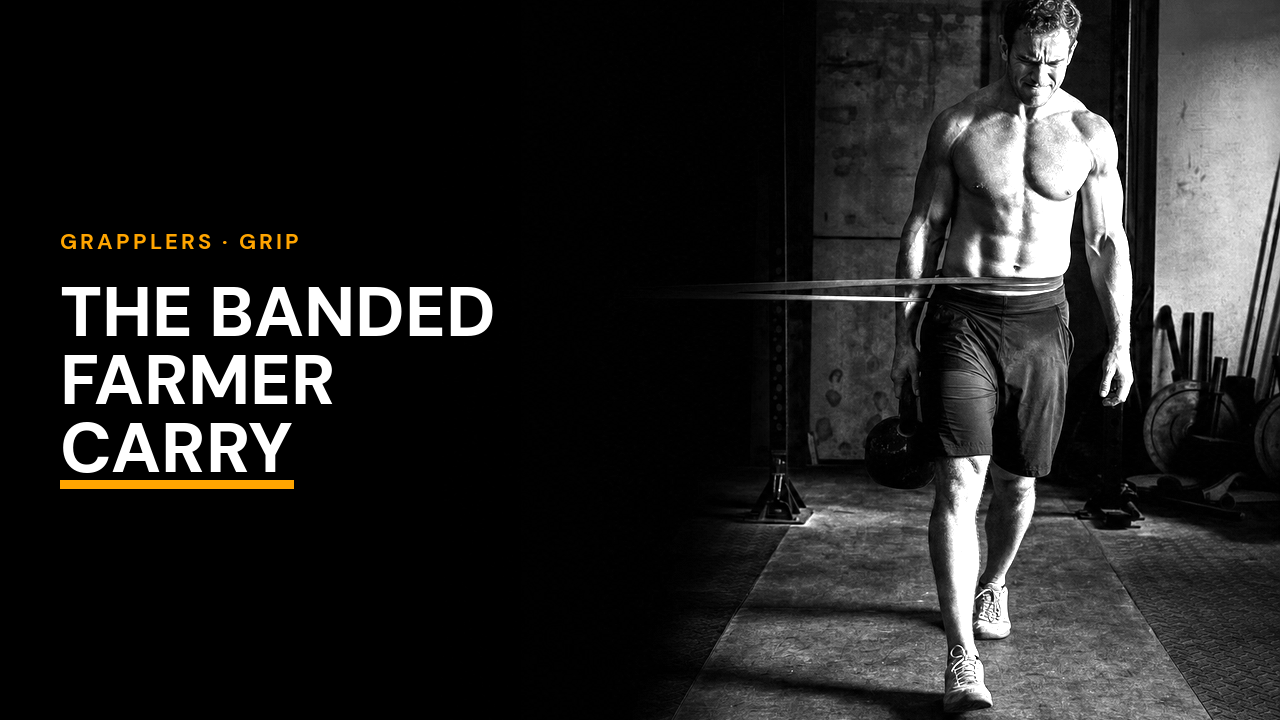
Jun 27, 2021The banded kettlebell farmer carry is a loaded carry with a band pulling the bell sideways or backward while you walk. That one change turns a straight-ahead grip and trunk exercise into something that fights you the whole way, which is much closer to what carrying another person actually feels like.
If you have ever stood up with someone hanging off you, or tried to walk a body across the mat, you know the load never stays still. It shifts, it pulls, it tries to spin you. A normal farmer carry does not train that. This one does.
Why Grapplers Should Care
Grappling almost never loads you symmetrically. Somebody is on one side, pulling one direction, and your job is to hold your frame anyway. The band is the cheapest way to build that into a carry.
- Trains the trunk to resist being pulled sideways while you are already loaded
- Builds grip endurance under time, not under reps
- Loads one side while the other side holds posture — the actual demand in a scramble
- Teaches you to keep breathing while braced, which is where most people fail
- Hard on the obliques and the deep trunk without a single sit-up
The point is not the weight. The point is holding your position while something drags you out of it.
How To Set It Up
- Anchor a band at hip height to a rack upright, a post, or a heavy loaded barbell.
- Loop the other end around a kettlebell handle, or hold the band in the same hand as the bell.
- Walk out until the band has real tension before you step off.
- Pick the bell up, get tall, ribs down, and start walking.
- Walk out and back for time, not for distance.
Three Band Directions, Three Different Jobs
| Band pulls | What it trains | What you will feel |
|---|---|---|
| Sideways, away from the bell | Anti-lateral flexion — the obliques on the loaded side | The side holding the bell lighting up |
| Sideways, toward the bell | Anti-lateral flexion on the opposite side | The unloaded side working to stop the lean |
| Backward, behind you | Forward drive and trunk bracing under a pull | Legs and trunk, closer to a sled push feel |
The Standards
Load and time matter more than distance here. Distance just tells you how big your gym is.
| Level | Bell weight | Time per side | Band tension |
|---|---|---|---|
| Starting out | Half bodyweight in one hand is too much — start at 25 percent | 30 seconds | Light |
| Competent | 35 to 40 percent bodyweight in one hand | 45 seconds | Moderate |
| Strong | 50 percent bodyweight in one hand | 60 seconds | Heavy |
If your shoulder is shrugging up toward your ear or your ribs are flaring, the bell is too heavy. Drop the weight. A carry you cannot hold posture in is not training posture.
How To Program It
This is finisher work or accessory work, not the main lift of the day. Two sessions a week is plenty.
THE SIMPLE VERSION
Twice a week, at the end of a lifting session
3 to 4 sets per side, 30 to 60 seconds each
Rest 60 to 90 seconds between sides
Add time before you add weight
It fits naturally alongside straight loaded carries and grip work. The full loaded carry progression covers the other ten variations and when to use each one, and the grip protocol covers the hand and forearm side of the same problem.
Mistakes That Kill The Exercise
- Going too heavy and turning it into a limp — the whole value is in holding position
- Walking too fast, which lets momentum carry you through the hard part
- Not enough band tension, so it is just a farmer carry with extra setup
- Holding your breath the entire set. Brace and breathe at the same time.
- Doing it for reps or distance instead of time
What To Pair It With
Carries build the frame. They do not build everything.
- Grip work — the limiting factor for most grapplers under 60 seconds
- Neck and upper back — holds posture when someone is on top of you
- Anti-rotation core work — same quality, unloaded, higher volume
- Isometric holds — builds the ability to hold a position under load
Common Questions
A standard loop resistance band works. Start lighter than you think — the band adds more than it looks like it will. Either works. A kettlebell hangs slightly differently and is a little harder on the grip, which is a small bonus. Yes, and a straight one-arm carry is still a good exercise. The loaded carry guide covers the unbanded versions. Six to eight weeks of consistent work is a realistic window for grip endurance and posture under load to change.Do I need a special band?
Kettlebell or dumbbell?
Can I do this without a band?
How long until I notice it in rolling?
This is one piece of a larger picture. The full strength and conditioning guide for grapplers covers how carries, strength, and conditioning fit together, and the exercise library has the rest of the movements.
Hands that hold on when the rest of you is done.
Start with the free Grappler’s Iron Hands 14-day challenge — hands, wrists, and forearms built to keep their grip deep into a hard roll. Or step into THE PHYSICAL GRAPPLER, built around mat-specific strength, grip, and conditioning.
Start Iron Hands FreeGet THE PHYSICAL GRAPPLERGrip last. Win late.