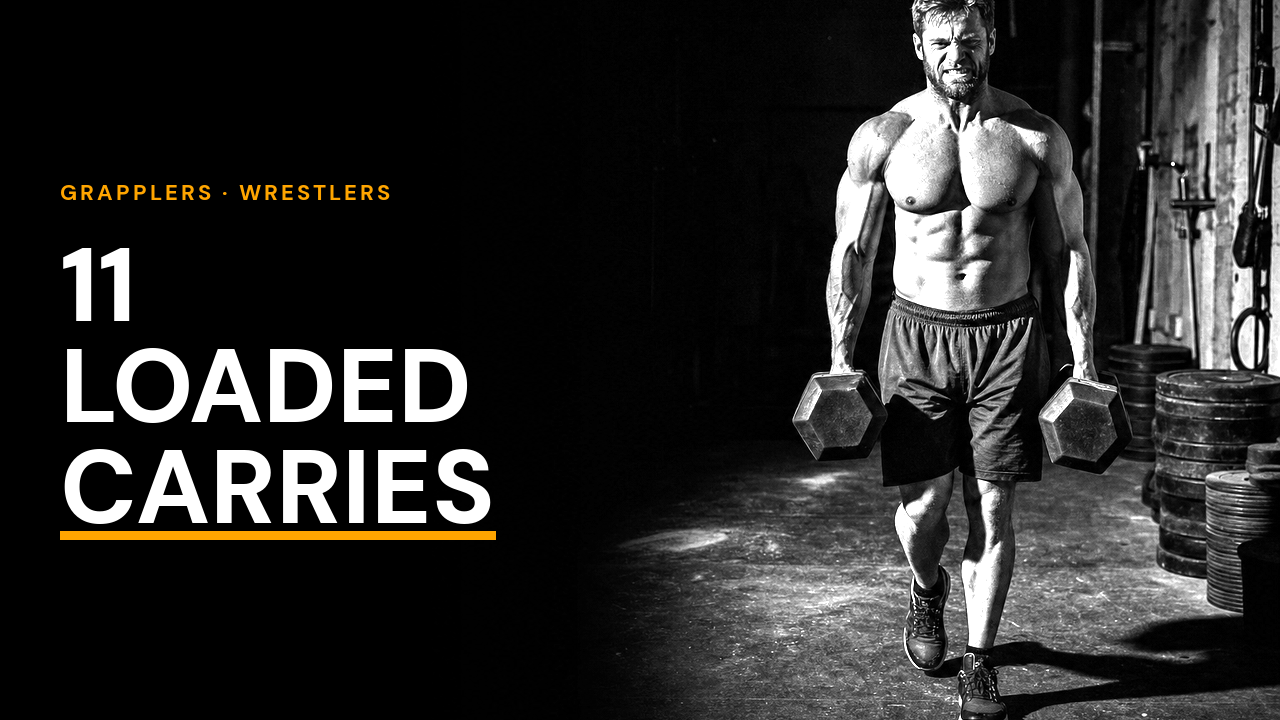
Loaded Carries for Grapplers: 11 Variations and How to Progress Them
Jun 26, 2021Loaded carries are the most honest strength exercise a grappler can do. You pick something heavy up, you hold your posture, and you walk. There is nowhere to hide and no way to cheat it with momentum.
They also happen to train the exact three things that decide grappling matches — grip, trunk, and the ability to hold a frame while something fights you. This is the full progression, from the version you start with to the ones that take years to earn.
Why Carries Beat Most Core Work For Grapplers
- They load the trunk while you are upright and moving, which is how grappling happens
- Grip is trained under time, which is what a match asks for
- They are self-limiting — you cannot cheat form once the weight is heavy
- They build work capacity without beating up your joints
- One exercise covers grip, trunk, upper back, and posture at the same time
Carries are not a warm-up and they are not filler. Loaded correctly, they are one of the hardest things in the gym.
The 11 Variations
Start Here
| Carry | What it trains | How to load it |
|---|---|---|
| Two-hand farmer carry | Grip, trunk, upper back — the baseline | Two bells or dumbbells, 25 percent bodyweight each hand |
| One-arm farmer carry | Anti-lateral flexion — the obliques | One bell, 35 percent bodyweight |
| Front-rack carry | Upper back and trunk under a front load | Two bells racked at the shoulders |
| Suitcase carry | Same as one-arm, held lower, harder on the grip | One bell or dumbbell held at the side |
Once Those Are Easy
| Carry | What it trains | How to load it |
|---|---|---|
| Overhead carry, one arm | Shoulder stability and trunk under an overhead load | Light — 15 to 20 percent bodyweight |
| Mixed carry (one overhead, one at side) | Trunk fighting two loads in two directions | Light overhead, moderate at the side |
| Bear hug carry | Trunk, upper back, and breathing under compression | Sandbag or heavy plate, hugged to the chest |
| Zercher carry | Trunk and upper back with the load in front, low | Barbell or sandbag in the elbow crease |
The Hard Ones
| Carry | What it trains | How to load it |
|---|---|---|
| Banded one-arm carry | Everything above, plus resisting a pull the whole way | Moderate bell, band anchored at hip height |
| Yoke or heavy sandbag walk | Whole-body bracing under a load you cannot argue with | Heavy. Short distances only. |
| Odd-object carry (sandbag, keg, body) | The closest thing to carrying a person | Whatever you have. Awkward is the point. |
The banded version is worth singling out because it is the one that most resembles a scramble. The full banded kettlebell farmer carry setup has the band directions, standards, and programming.
How To Progress Them
The order matters. Most people jump to the awkward stuff before they can hold posture under a simple load.
- Two-hand farmer carry until 40 percent bodyweight per hand for 60 seconds feels controlled.
- One-arm and suitcase carries until you can hold 40 percent bodyweight for 45 seconds per side without leaning.
- Front-rack and bear hug carries — these expose breathing problems fast.
- Overhead and mixed carries once your shoulders can hold position under light load.
- Banded and odd-object carries. These are the point of the whole progression.
Add time before you add weight, and add weight before you add awkwardness. Skipping steps is how people hurt their low back on carries.
Programming Carries Into A Grappling Week
Carries go at the end of a session. They are demanding but they are not the priority when you are also training on the mat.
THE CARRY WEEK
Two sessions a week, at the end of lifting
One straight carry (farmer, front-rack, or suitcase) — 3 to 4 sets of 45 to 60 seconds
One harder carry (banded, bear hug, or odd-object) — 2 to 3 sets, shorter
Total time: about 10 minutes per session
Do not add carries on a day you rolled hard and lifted heavy
The weekly scheduling templates cover where this fits when you are training jiu-jitsu three to five times a week.
What Carries Fix
| Problem | How carries help |
|---|---|
| Grip dies in round two | Carries train grip under time, which is the actual demand |
| You get flattened and folded | Anti-lateral and anti-flexion work builds the frame you hold |
| Low back hurts after rolling | Teaches the trunk to brace upright instead of the back doing it alone |
| You gas out standing up with someone on you | Loaded carries build exactly that work capacity |
| Your posture breaks when someone drives into you | Front-rack and bear hug carries train that position directly |
If grip is your specific failure point, the grip protocol is a faster route. If it is posture under pressure, start with the three assets that decide grappling matches.
Mistakes
- Going too light and treating carries as a warm-up
- Going too heavy and shrugging, leaning, or holding your breath the whole way
- Measuring in laps instead of seconds
- Doing every variation every week instead of two done well
- Adding awkward objects before you can hold posture under a simple load
Common Questions
A useful benchmark is bodyweight total, split across two hands, for 60 seconds with clean posture. Half bodyweight per hand is a strong standard. Time. Distance depends on how much room you have, which tells you nothing about training. Yes, and a trap bar carry is one of the best ways to load a two-hand carry heavy. Grip becomes the limiter, which is fine. Twice a week is enough alongside mat training. Three times only if you are lifting and not training much jiu-jitsu. No. Carries train holding a position. Hinging trains producing force. You want both.How heavy should a farmer carry be?
Distance or time?
Can I use a trap bar?
How often?
Do carries replace deadlifts?
The full strength and conditioning guide for grapplers puts carries in context with the rest of the training year, and the exercise library has demonstrations for the movements above.
Hands that hold on when the rest of you is done.
Start with the free Grappler’s Iron Hands 14-day challenge — hands, wrists, and forearms built to keep their grip deep into a hard roll. Or step into THE PHYSICAL GRAPPLER, built around mat-specific strength, grip, and conditioning.
Start Iron Hands FreeGet THE PHYSICAL GRAPPLERGrip last. Win late.